
The MTLE explained7-minute readFor MTLE takers
The six MTLE subjects and their weights, and what that means for your review
The six MTLE subjects and their weights: four papers at 20%, two at 10%, the two-day timetable, and how to split your review hours sensibly.
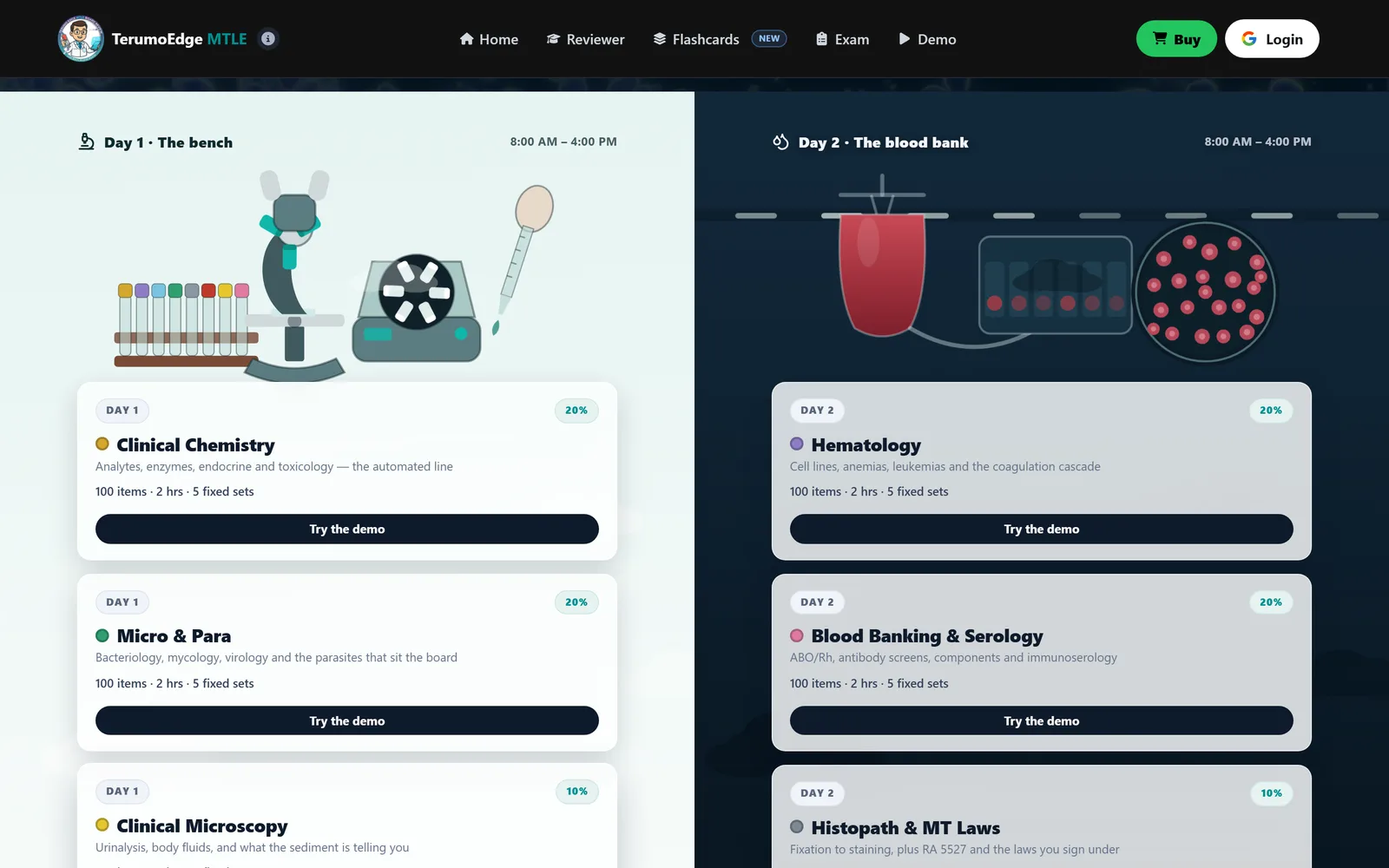
The MTLE subjects are six papers, and they are not equal. Four of them carry 20% of your rating each, and two carry 10% each. Knowing that split early is the cheapest way to stop over-reviewing a favourite subject and under-reviewing the one that quietly sinks results.
This post lists the six subjects with their weights, explains what the two weight tiers mean, shows the two-day timetable from a recent exam program, and turns the weights into a practical split of review hours. Where a detail comes from a secondary source, the text says so.
What are the six MTLE subjects and their weights?
The six MTLE subjects and their weights come from Section 17 of Republic Act No. 5527, the Philippine Medical Technology Act of 1969. Clinical Chemistry, Microbiology and Parasitology, Hematology, and Blood Banking and Serology are 20% each. Clinical Microscopy and Histopathologic Technique are 10% each.
| Paper | Subject | Weight |
|---|---|---|
| 1 | Clinical Chemistry | 20% |
| 2 | Microbiology and Parasitology | 20% |
| 3 | Hematology | 20% |
| 4 | Blood Banking and Serology | 20% |
| 5 | Clinical Microscopy | 10% |
| 6 | Histopathologic Technique | 10% |
The weights add up to 100%. The paper numbers here are only a reading order for this table, not the order in which the papers are sat. The sitting order is in the timetable further down.
The statute is the source we can cite for these weights. If PRC publishes a later board resolution that changes them, that resolution governs, so check PRC announcements for your own sitting.
Why do four MTLE subjects carry 20% each?
Four subjects carry 20% each because the statute gives the bench-heavy disciplines the largest share: Clinical Chemistry, Microbiology and Parasitology, Hematology, and Blood Banking and Serology together make up 80% of the rating. The law does not explain its reasoning, so any story about why is speculation. What you can rely on is the arithmetic.
Because the four are equal, a weak 20% paper costs the same as any other weak 20% paper. If you score 60% in Hematology instead of 80%, you lose four points off a general average, since 20 points of weight multiplied by a 20-point gap is four. The same gap in a 10% paper costs two points.
That makes the 20% papers the natural backbone of a review plan. Our Clinical Chemistry review guide works through one of them in detail, and the paper's weight is the reason it gets a dedicated block.
What are the two 10% MTLE subjects?
The two 10% subjects are Clinical Microscopy and Histopathologic Technique. Together they carry 20% of the rating, which is exactly one 20% paper's worth, so treating them as optional extras is a mistake.
Paper 6 has two names in the sources, and both are worth knowing. The statute, Section 17 of RA 5527, says "Histopathologic Technique". A recent exam program, relayed by the secondary site Exams Pinas, lists the final paper as "Histopathologic Techniques, Medical Technology Laws and Ethics".
We cannot tell you from our sources how the 10% is divided between the technique content and laws and ethics, and we do not state a split. What we can say is that a recent program groups them in one paper, so a reviewee should prepare for both. The product's own paper picker labels this paper "Histopath & MT Laws", which is the product's label and not a PRC title.
How are the six papers laid out over two days?
A recent program shows six 2-hour papers over two days, from 8:00 AM to 4:00 PM each day. This timetable comes from the August 2025 program as relayed by Exams Pinas, a secondary source that says it passes on PRC guidelines. Treat it as the recent pattern, not a rule for your sitting.
| Day | 8:00 to 10:00 AM | 11:00 AM to 1:00 PM | 2:00 to 4:00 PM |
|---|---|---|---|
| Day 1 | Clinical Chemistry | Microbiology and Parasitology | Clinical Microscopy |
| Day 2 | Hematology | Blood Banking and Serology | Histopathologic Techniques, Medical Technology Laws and Ethics |
Notice how the weights fall across the days. Day 1 holds two 20% papers and the 10% Clinical Microscopy. Day 2 holds two more 20% papers and the other 10% paper. Neither day is a light day. PRC's 2026 schedule of examinations lists the MTLE on two dates in the year, and the schedule and exam day post covers dates and what to bring.
How should the weights shape your review hours?
Split your review hours roughly in proportion to the weights, then shift time toward your weakest paper. A simple default is two hours for each 20% subject and one hour for each 10% subject out of every ten hours of study. That is a suggestion, not a PRC requirement.
Here is how it looks for a 100-hour block: 20 hours each for Clinical Chemistry, Microbiology and Parasitology, Hematology, and Blood Banking and Serology, and 10 hours each for Clinical Microscopy and Histopathologic Technique.
Then adjust. If you consistently score lowest in Blood Banking and Serology, you may give it 28 hours and take the difference from a subject you already handle well. What you should not do is let any paper fall to nothing. Section 19 of RA 5527 sets "no rating below fifty per cent in any of the major subjects", so a neglected 10% paper can still end an attempt.
| Subject | Weight | Hours in a 100-hour block |
|---|---|---|
| Clinical Chemistry | 20% | 20 |
| Microbiology and Parasitology | 20% | 20 |
| Hematology | 20% | 20 |
| Blood Banking and Serology | 20% | 20 |
| Clinical Microscopy | 10% | 10 |
| Histopathologic Technique | 10% | 10 |
What do the weights not tell you?
The weights do not tell you how hard a paper is, how many items it has, or how PRC divides a paper into topics. They give each subject's share of the rating, and nothing else.
Our sources do not state PRC's number of items per paper, so we do not give one. The 100-item sets in TerumoEdge are the product's own design for rehearsal, not a copy of PRC's papers.
The weights also do not tell you where you personally lose marks. A reviewee who loves Clinical Chemistry may still drop points on calculations, and one who dreads Microbiology may find the identification flow easy once it is drawn out. Only timed practice shows that.
So use the weights to set the starting split, and your own scores to correct it. The rule is the same either way: keep every subject above the 50% floor first, then push the average past 75%.
How does TerumoEdge map to the six subjects?
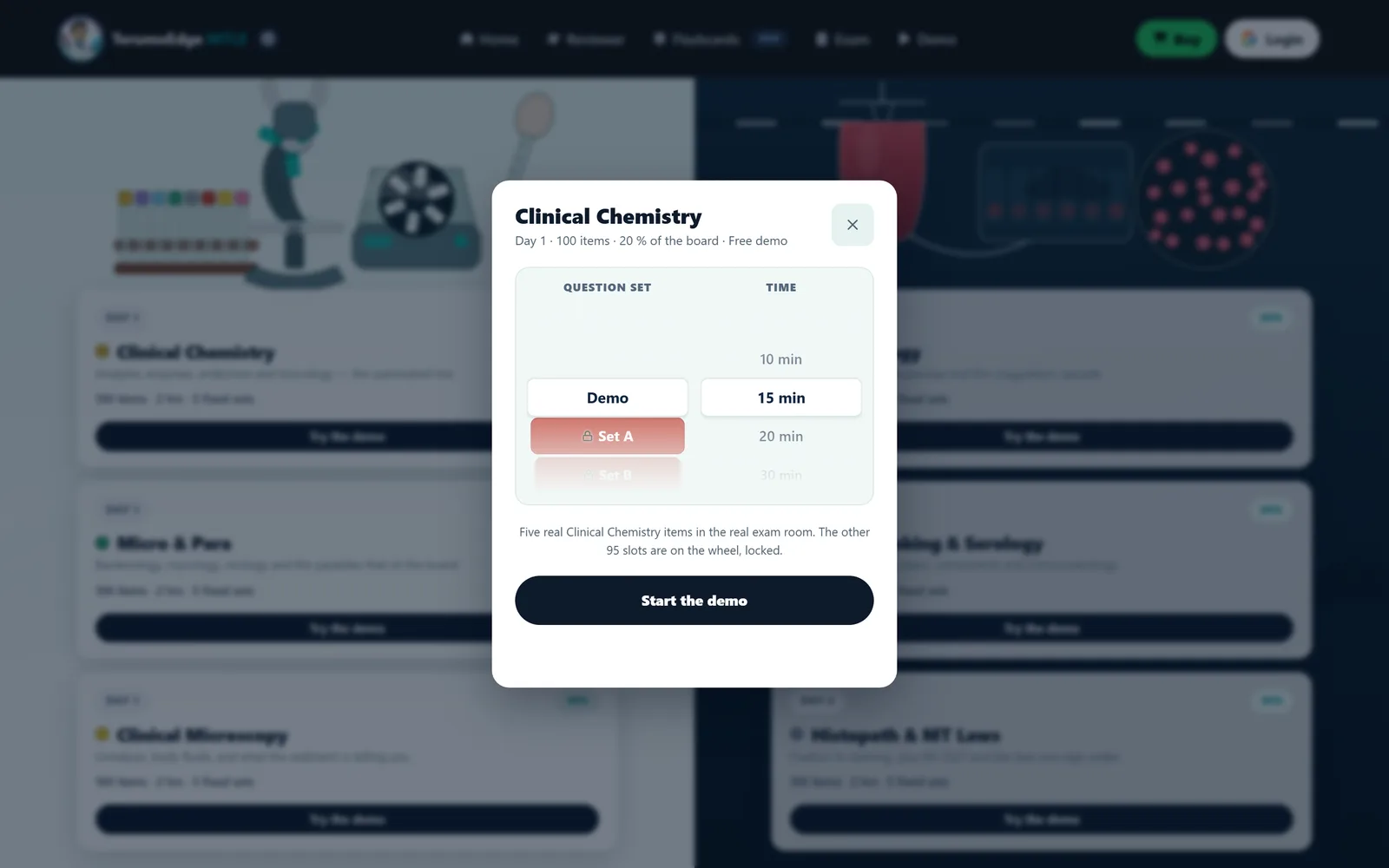
TerumoEdge MTLE Ex-Sim mirrors the six-subject layout: 3,000 items across the six board subjects, in five board-length sets of 100 items per subject. That item count is the product's own design, not a PRC figure, and PRC's papers may differ.
Disclosure: TerumoEdge publishes this blog, so weigh the product claims accordingly. You can check them yourself in the free demo, which gives five free items per board subject and shows the full explanation for each.
The practical value is the rehearsal. Sitting a 2-hour set in one subject, then reading why each option was right or wrong, is closer to the real day than reading a reviewer. The study plan post shows how to build those sets into a weekly routine.
Frequently asked questions
Which MTLE subjects weigh the most?
Clinical Chemistry, Microbiology and Parasitology, Hematology, and Blood Banking and Serology weigh the most, at 20% each under Section 17 of RA 5527. Clinical Microscopy and Histopathologic Technique carry 10% each. The four 20% subjects together make up 80% of the rating.
How long is each MTLE paper?
A recent PRC program, relayed by the secondary site Exams Pinas, shows each of the six papers as two hours long. Three papers are sat on each of two days, between 8:00 AM and 4:00 PM. Check the program for your own sitting, because PRC publishes it for each exam.
Are laws and ethics tested on the MTLE?
A recent program lists the final paper as "Histopathologic Techniques, Medical Technology Laws and Ethics", so it appears to be grouped with histopathology. The statute itself names the subject "Histopathologic Technique". Prepare for both, and confirm the paper's title in the PRC program for your sitting.
Do the weights change between sittings?
Our sources show the weights only as written in Section 17 of RA 5527, and we found no later board resolution that changes them. If PRC or the Board issues one, it would govern. Read the announcements for your sitting before you finalise your plan.
Sources
From the publisher
Meet the MTLE here first.
TerumoEdge MTLE is an MTLE simulator: board-length practice sets in all six board subjects, sat on a clock, with a full explanation for every item instead of a bare answer key.
- 3,000 items across the six MTLE board subjects, 500 in each
- five board-length sets of 100 items per subject
- A full explanation for every item, not a bare answer key
- A visual reviewer and flashcards beside the question bank
Try the free MTLE simulator demo Five real items per board subject. No account needed.
About this article
Written by the TerumoEdge editorial team, who build the TerumoEdge MTLE Ex-Sim. Exam facts are checked against RA 5527, the Philippine Medical Technology Act of 1969, Professional Regulatory Board of Medical Technology resolutions and PRC announcements, and every article lists its sources. How we write and check our articles.
First published .