
MTLE guides for medical technology graduates
Straight answers for medical technology graduates heading into the MTLE: what each of the six board subjects covers, how to pace your review, and how an MTLE simulator compares with a review center, a PDF reviewer or a free question group. Every exam fact is sourced.
 Start here
What an MTLE simulator is, and why reading reviewers isn't enough
What an MTLE simulator is, what it reproduces from the board exam, and how it differs from a reviewer or a review center. Includes a free demo.Comparisons
-
Comparisons
ChatGPT for MTLE review: where chatbots help and where they mislead
Where ChatGPT for MTLE review helps, where a chatbot misleads on ranges, units and invented rationales, and a safe workflow for board prep. -
Comparisons
How to choose an MTLE reviewer app: nine criteria that matter
Nine criteria for choosing an MTLE reviewer app, a 10-minute demo test and the red flags to avoid. A guide by category, with no rankings. -
Comparisons
MTLE review center or self review? An honest comparison
Compare an MTLE review center with self review: structure, cost of time, flexibility and what both still need. A fair, category-level guide. -
Comparisons
MTLE reviewer PDFs vs a simulator: which one moves your score
A fair comparison of an MTLE reviewer in PDF form and an MTLE simulator: what each trains, where each stops and how to combine them. -
Comparisons
MTLE vs ASCPi vs AIMS: three exams for three different careers
MTLE vs ASCPi vs AIMS: three exams run by three different bodies. See which one fits your plan, what to confirm with each body and how to sequence them.
The MTLE explained
-
The MTLE explained
Scored at least 70% but did not pass? The Medical Laboratory Technician route
What PRC says about the medical laboratory technician route: a general rating of at least 70% below passing, where it is stated and how to plan your next step. -
The MTLE explained
The MTLE passing score: the 75% average, the 50% floor, and retakes
The MTLE passing score explained: a 75% general average, no rating below 50% in a major subject, a worked example, and the refresher after three failures. -
The MTLE explained
MTLE passing rates by sitting, and what they tell a reviewee
MTLE passing rate for six recent PRC sittings, with examinees, passers, release times and an honest reading of the March and August pattern. -
The MTLE explained
The MTLE schedule and exam day: dates, timetable and checklist
The MTLE schedule explained: two sittings a year, the two-day timetable of six papers, the exam-day checklist and how to plan backwards from your date. -
The MTLE explained
The six MTLE subjects and their weights, and what that means for your review
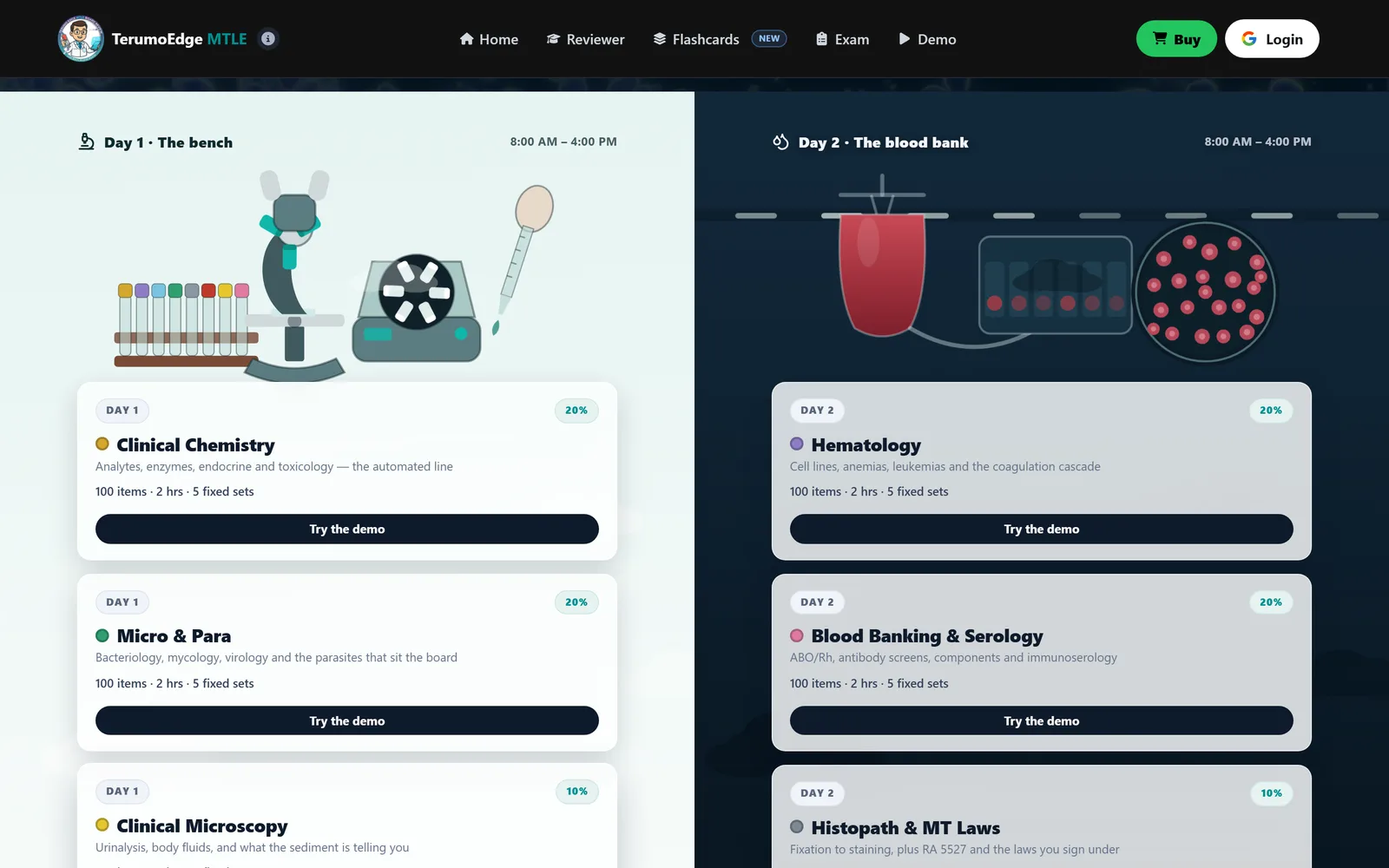
The six MTLE subjects and their weights: four papers at 20%, two at 10%, the two-day timetable, and how to split your review hours sensibly.
Study strategy
-
Study strategy
Clinical Chemistry MTLE review: how to study a 20% paper
A practical method for clinical chemistry MTLE review: organ panels, method principles, quality control and calculations, with drills for each. -
Study strategy
Hematology MTLE review with Blood Banking: two 20% papers, one plan
Plan your hematology MTLE review with blood banking and serology: morphology by pattern, hemostasis pathways, compatibility logic and a two-week block. -
Study strategy
MTLE tips for the last 30 days: a week-by-week plan
MTLE tips for the final month: rehearse the two-day sitting, repair your weakest subject, protect recall, and taper. A week-by-week plan with do and don't. -
Study strategy
Microbiology MTLE review with Parasitology: how to study a 20% paper
Microbiology MTLE review with parasitology: bacteria by group, identification flow, fungi and viruses, and life cycles by stage, plus a two-week block. -
Study strategy
Clinical Microscopy MTLE review: why the 10% papers, Histopath included, still decide results
Clinical microscopy MTLE review: why the two 10% papers matter because of the 50% floor, and an efficient plan for urinalysis, histotechniques and laws. -
Study strategy
A 12-week MTLE study plan built around timed sets
A 12-week MTLE study plan: subject blocks by weight, full two-day rehearsals and a taper week, with tables you can adapt to your own sitting. -
Study strategy
MTLE anxiety: how to stay steady through two exam days
MTLE anxiety is common and manageable. Build familiarity, stamina and a reset routine for two exam days, and know when to ask for professional support. -
Study strategy
MTLE time management: how to pace a two-hour paper
MTLE time management for a two-hour paper: the pacing formula, checkpoints, long and calculation items, the last ten minutes and how to train your pace.
Your situation
-
Your situation
First-time MTLE taker? What to do from graduation to exam day
A guide for the first time MTLE taker: the rules, the subject weights, how to choose a review structure and what to do in your first month. -
Your situation
MTLE retaker? A plan that changes the result next sitting
An MTLE retaker plan: find out whether you missed the 75% average or the 50% floor, diagnose the cause, and build a 10-week plan around it. -
Your situation
How to review for the MTLE while working: a schedule that holds
How to review for the MTLE while working: a weekday and weekend schedule, phone recall in small pockets, and how to use leave in the final month.
From the publisher
Meet the MTLE here first.
TerumoEdge MTLE is an MTLE simulator: board-length practice sets in all six board subjects, sat on a clock, with a full explanation for every item instead of a bare answer key.
- 3,000 items across the six MTLE board subjects, 500 in each
- five board-length sets of 100 items per subject
- A full explanation for every item, not a bare answer key
- A visual reviewer and flashcards beside the question bank
Try the free MTLE simulator demo Five real items per board subject. No account needed.