
Study strategy8-minute readFor reviewees tackling Clinical Chemistry
Clinical Chemistry MTLE review: how to study a 20% paper
A practical method for clinical chemistry MTLE review: organ panels, method principles, quality control and calculations, with drills for each.
Clinical Chemistry is the paper most reviewees fear, because it looks like a wall of analytes, enzymes and formulas. Clinical chemistry MTLE review gets much easier once you stop treating the subject as a list and start treating it as a set of stories about organs. This guide gives you that structure, the way items tend to test each part, and drills you can run this week.
It teaches method only. The topics here are the standard ones in any clinical chemistry course, and nothing in this guide claims to know what a particular sitting will ask. For where this paper sits among the six, see the six MTLE subjects and their weights.
Why does Clinical Chemistry matter so much for the MTLE?
Clinical Chemistry carries 20% of the board rating under the weights in RA 5527, the Philippine Medical Technology Act of 1969. That is double the weight of Clinical Microscopy or Histopathologic Technique, and it is shared with three other subjects. A recent PRC program, relayed by Exams Pinas, places it first on Day 1, from 8:00 to 10:00 AM, so it is also the paper that meets you while you are still settling in.
The same statute asks for a general average of at least 75% with no rating below 50% in any major subject. Clinical Chemistry therefore cannot be skipped and cannot be ignored in favour of a stronger subject. The passing score and rules explained post shows how the arithmetic works.
How should you organise Clinical Chemistry by organ panel?
Organise Clinical Chemistry by organ, because items tend to hand you a pattern of results and ask what the organ is doing. Build one page per organ with three columns: what is measured, which way each value moves in disease, and what pushes it the wrong way outside the body.
- Liver: bilirubin fractions, AST, ALT, ALP, GGT, albumin, ammonia. Learn the pattern for hepatocellular injury (transaminases lead) versus obstruction (ALP and GGT lead).
- Kidney: urea, creatinine, uric acid, clearance concepts, electrolytes and acid-base basics.
- Heart: troponin as the preferred marker for myocardial injury, with CK-MB and the older markers as history and comparison.
- Pancreas and gut: amylase, lipase, glucose and its regulation.
- Endocrine: thyroid function patterns, cortisol, and the feedback loops that explain them.
A feedback loop is worth drawing. If TSH is high and free T4 is low, the thyroid is failing, not the pituitary. One drawn arrow replaces four memorised lines.
Which methods and principles should you know?
Know each method by what it physically measures, because items often ask what the instrument sees rather than what the analyte is. Spectrophotometry follows Beer's law, so absorbance rises in proportion to concentration when the path length stays fixed. Flame photometry and ion-selective electrodes serve electrolytes. Electrophoresis separates proteins by charge, and immunoassays depend on the antibody and its label.
Make a short card for every method with three lines: the signal, what can distort it, and one analyte it is used for. Interference is where items hide their marks. A haemolysed sample raises potassium because red cells are rich in it. A lipaemic sample scatters light and can disturb photometric readings. Icterus can interfere with some colour reactions.
The habit to build is asking, "what could make this number wrong before I believe it?"
How does quality control show up on the paper?
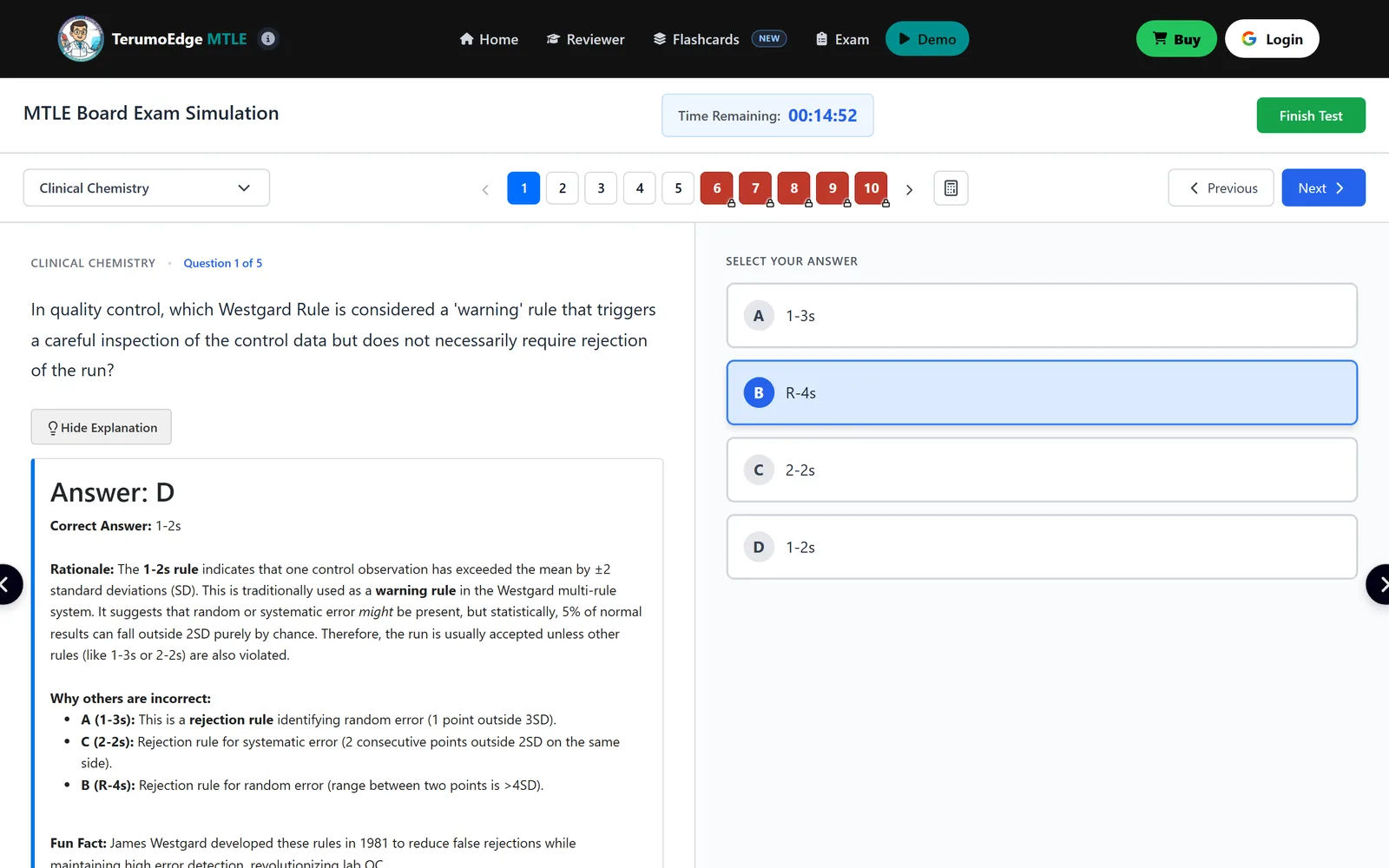
Quality control items test whether you can read a pattern, so draw it. Start with the vocabulary: accuracy against precision, mean, standard deviation and coefficient of variation, and the Levey-Jennings chart that plots control values against limits set at the mean and multiples of the standard deviation.
Then learn the two error families. Random error scatters results and shows up as loss of precision. Systematic error moves results in one direction and appears as a shift (an abrupt, sustained change) or a trend (a gradual drift). Know the likely causes of each: a new reagent lot or recalibration often produces a shift, while a slowly deteriorating reagent or a ageing lamp produces a trend.
Finally, learn the logic of multirule quality control without memorising it as a chant. Each rule exists to catch one kind of error, and each is either a warning to look closer or a reason to reject the run. Ask yourself of every rule, "does this one detect random error or systematic error?"
What calculations should you drill?
Drill calculations in short, daily sets, because they are the most learnable marks in the paper. Reviewees who dread them usually lose points to setup mistakes, not to arithmetic. The standard families are small.
| Topic | What to know | How to drill |
|---|---|---|
| Dilutions | Serial and simple dilution factors; final concentration after dilution | Ten problems daily, written out in full |
| Molarity, normality, percent solutions | Preparing a solution from stock | Convert the same quantity three ways |
| Beer's law | Absorbance proportional to concentration; unknown from a standard | Solve with a one-point calibration |
| Clearance and anion gap | Plug-in formulas with units | Write the formula, then the units, then the numbers |
| Statistics for QC | Mean, SD, CV | Compute from five values by hand |
| Unit conversion | Conventional to SI and back | Make a one-page conversion strip |
Check the units before you check the answer. A result that is off by a factor of ten almost always means a unit or a dilution step went wrong, and that is how you spot it during a timed paper.
What does a two-week Clinical Chemistry block look like?
A two-week block works when each day has one job and ends with a timed set. Use the product's practice sets as units: a board-length set holds 100 items, and the bank has five sets for each subject.
| Days | Focus | End-of-day task |
|---|---|---|
| 1-2 | Liver and kidney panels | Twenty items, explanations read in full |
| 3-4 | Heart, pancreas, endocrine | Twenty items plus a drawn feedback loop |
| 5 | Electrolytes, acid-base | Twenty items, then a recall card review |
| 6-7 | Methods and principles | Rest day plus one flashcard session |
| 8-9 | Quality control | Draw three Levey-Jennings patterns from memory |
| 10-11 | Calculations | Fifteen problems, formulas written first |
| 12-13 | Mixed weak areas | One timed set of 100 items |
| 14 | Review | Re-do only the missed items; list your rules |
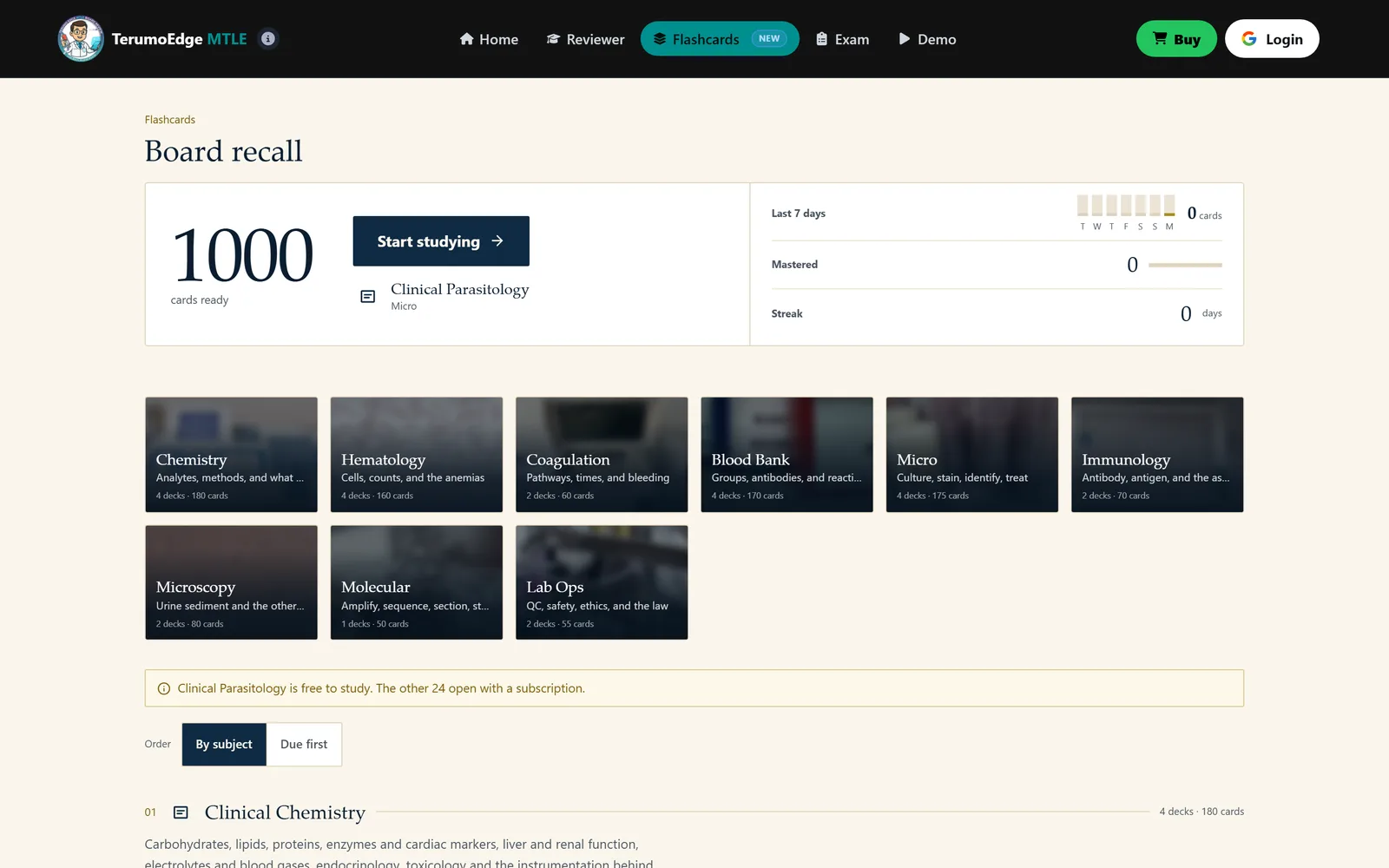
Pair this with the visual reviewer at /learn/ when a mechanism will not stay in your head, and keep your one-line rules on flashcards so they come back at spaced intervals.
What does a clinical chemistry MTLE item usually ask you to do?
Clinical chemistry MTLE items tend to fall into four jobs: recall a fact, read a pattern, spot an interference, or compute a value. Knowing which job an item wants is half of answering it, and it tells you how much time to spend.
A recall item asks for a definition, a principle or a name. It should cost you a few seconds, and if it does not, that topic belongs on flashcards. A pattern item gives a short set of results and asks what is going on in the patient. A raised bilirubin with a very high ALP and GGT, and only mildly raised transaminases, points you to obstruction rather than hepatocyte injury. An interference item describes a sample problem and asks what the result really means, or what to do next. A calculation item asks you to produce a number, and the units usually tell you whether you set it up correctly.
When you review, label every missed item with one of those four jobs. After two weeks the labels show you where your marks actually go, which is often not where you assumed.
How do you turn a missed item into a point?
Treat every miss as a rule you did not own. After a set, sort misses into three piles: did not know it, knew it but misread, and calculation slip. The first pile goes to flashcards, the second to a slowing-down habit, and the third to more daily arithmetic.
Then write the rule in one line, in your own words, and say it aloud. "Hepatocellular injury lifts transaminases first; obstruction lifts ALP and GGT first." That sentence will travel with you on exam morning. A corrected answer you only read once will not.
If you want the full discipline behind this, the same logic is covered for the whole bank in the study plan, and the free demo lets you feel how an explanation changes the way you read the next item. You can try it at the free demo.
Frequently asked questions
How heavy is Clinical Chemistry on the MTLE?
Clinical Chemistry carries 20% of the board rating under the weights in RA 5527. It is one of four subjects at that weight, alongside Hematology, Microbiology and Parasitology, and Blood Banking and Serology. Clinical Microscopy and Histopathologic Technique carry 10% each.
Should I memorise reference ranges?
Memorise the direction and the reason, and a rough range for the analytes you meet most. Reference intervals vary by laboratory, method, population and unit system, so a single remembered number is fragile. Items usually test whether a value is high, low or normal in context, so knowing the pattern is safer than knowing the digits.
How do I handle calculation items without losing time?
Write the formula first, then the units, then the numbers. Practise one short set daily so the setup feels automatic. If a calculation is taking more than a minute during a paper, mark it, answer the others, and return. The time management guide explains pacing.
Can I skip Clinical Chemistry if I am strong in other subjects?
No. The statute requires no rating below 50% in any major subject, in addition to a general average of at least 75%. A strong paper elsewhere cannot repair a failing Clinical Chemistry rating.
Sources
From the publisher
Meet the MTLE here first.
TerumoEdge MTLE is an MTLE simulator: board-length practice sets in all six board subjects, sat on a clock, with a full explanation for every item instead of a bare answer key.
- 3,000 items across the six MTLE board subjects, 500 in each
- five board-length sets of 100 items per subject
- A full explanation for every item, not a bare answer key
- A visual reviewer and flashcards beside the question bank
Try the free MTLE simulator demo Five real items per board subject. No account needed.
About this article
Written by the TerumoEdge editorial team, who build the TerumoEdge MTLE Ex-Sim. Exam facts are checked against RA 5527, the Philippine Medical Technology Act of 1969, Professional Regulatory Board of Medical Technology resolutions and PRC announcements, and every article lists its sources. How we write and check our articles.
First published .