
Study strategy7-minute readFor reviewees tempted to skip the 10% papers
Clinical Microscopy MTLE review: why the 10% papers, Histopath included, still decide results
Clinical microscopy MTLE review: why the two 10% papers matter because of the 50% floor, and an efficient plan for urinalysis, histotechniques and laws.
When time is short, the two smallest papers are the first to be cut. A clinical microscopy MTLE review and the histopathology paper each carry 10%, so it feels reasonable to give them leftover hours. That instinct has a cost, and this post explains why. It also gives you an efficient way to review urinalysis and body fluids, histopathologic techniques and laws and ethics without letting them swallow your calendar.
A small weight does not mean a small risk. The next section shows why.
Why does a 10% paper carry real risk?
A 10% paper carries real risk because the pass rule has a floor, not only an average. RA 5527 requires a general average of at least 75% in the written test, with no rating below 50% in any of the major subjects. Clinical Microscopy and Histopathologic Technique are both listed among the weights, at 10% each.
Here is the arithmetic of the risk. A strong average can absorb a modest score in a small paper, but it cannot erase a rating below 50%. A reviewee who ignores a 10% paper and then scores under half on it can fail the exam while doing well elsewhere. The cost of a few focused hours is small compared with that outcome.
| Paper | Weight | Floor | Efficient method |
|---|---|---|---|
| Clinical Microscopy | 10% | No rating below 50% | Short, frequent drills on urine and body fluid patterns |
| Histopathologic techniques | 10% | No rating below 50% | Learn the sequence of steps and why each exists |
| Laws and ethics (in the program's paper 6) | Part of paper 6 | Same floor, as part of that paper | Read the key provisions once, then test recall |
How is paper 6 named, and why does it matter?
Paper 6 is named differently depending on the source, so confirm the title in the program for your sitting. The statute lists the subject as "Histopathologic Technique". A recent exam program, as relayed by a secondary source, names it "Histopathologic Techniques, Medical Technology Laws and Ethics".
Treat the second title as a signal, not a settled fact. That source is secondary and describes the 2025 sitting, so it is not a rule for every later one. The safe approach is to prepare histotechniques as the core and give laws and ethics a modest, real share of your time. Then read the PRC program for your own sitting when it is released, so nothing surprises you.
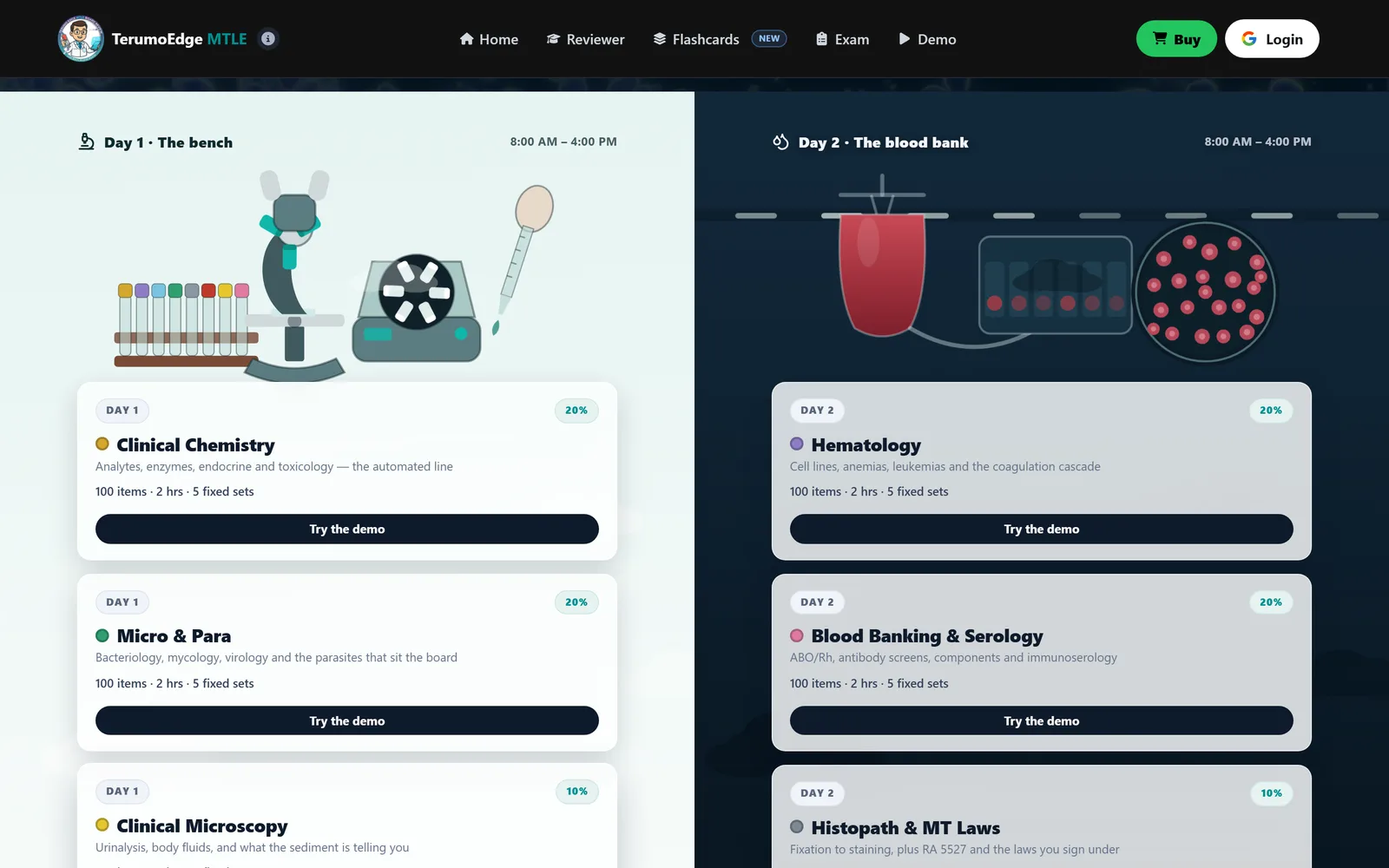
TerumoEdge labels the sixth paper in its own way in the demo, as "Histopath & MT Laws", and the bank has five sets of 100 items for each subject. That is the product's design, not a statement about PRC's papers.
How should you approach clinical microscopy MTLE review?
Review Clinical Microscopy as a set of patterns, because the paper rewards recognising findings in urine and other body fluids. Work in this order: specimen collection and handling, the physical and chemical examination, the microscopic examination of urine, then other body fluids such as cerebrospinal and serous fluids and semen. Learn what a normal finding looks like first, then the abnormal ones and what they suggest.
Drill with short, frequent sessions: fifteen minutes on casts one day, crystals the next, reagent strip principles after that. Quick tests of causes and interferences pay off because each can show up as a small recall item. A visual reviewer helps with the shapes and appearances, so use pictures alongside your notes.
The microbiology and parasitology guide covers a neighbouring paper that uses a similar identify-by-clue approach.
How should you review histopathologic techniques?
Review histopathologic techniques as a sequence, because most items test the order of steps and the purpose of each. Learn the path a tissue takes: collection and fixation, tissue processing, embedding, sectioning, staining and mounting. For each step, learn what it does, what can go wrong and which reagents or equipment are involved.
Group your notes by problem as well. When a section is too thick, the stain is uneven or tissue is poorly fixed, what are the likely causes? Troubleshooting questions are common in lab practice and reward understanding of the reason behind each step, not memorised lists. Add the main categories of stains and their general purposes, and the principle of frozen sections.
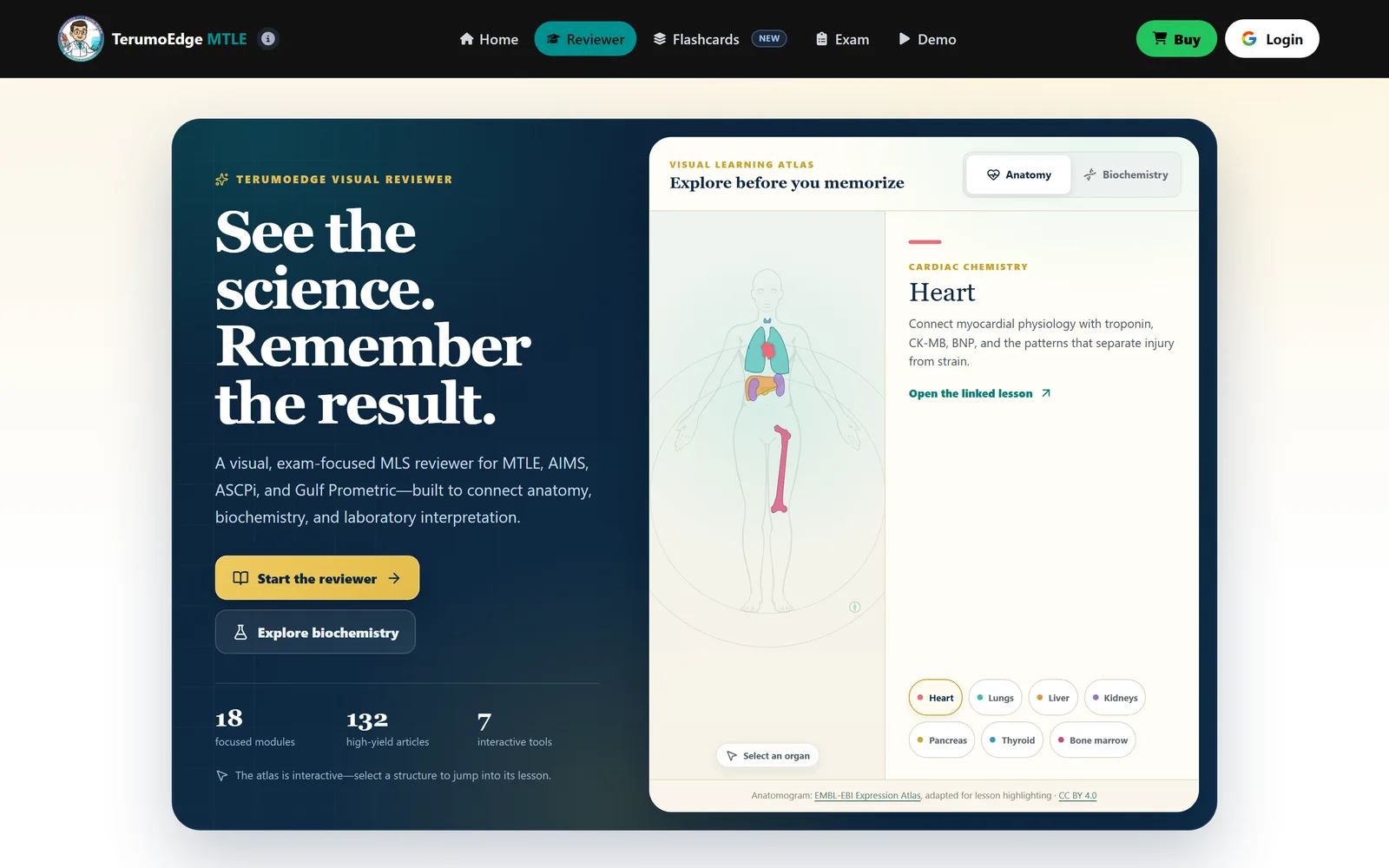
Keep the content general and conceptual. Use your textbook and course notes as the authority, and use timed items to test whether you can apply the steps. The reviewer at /learn/ offers a visual way to see processes laid out when diagrams help you remember.
What about laws and ethics?
Treat laws and ethics as a small reading task, because the paper content is likely to centre on the legal and professional framework of the profession. The statute itself, RA 5527, is the Philippine Medical Technology Act of 1969, so read it as a core text. Notice how it describes the scope of the profession, the examination and registration.
Make a one-page summary of the main provisions and the professional responsibilities you learned in your course. Then test yourself with short recall questions, such as who may take the exam and what the pass rule says. Keep the content general, since this post cannot confirm how any one program distributes items.
Do not skip it on the grounds that it is "just reading". It is part of the sixth paper, so it shares the 50% floor with the histotechnique content. If your course covered ethics and laws recently, one careful read plus a few practice items may be enough.
A useful test is to close your notes and explain, in three sentences, what the law says about who may sit the examination, how it is scored and what happens after repeated failures. If you stumble, you have found your next reading task. Repeat the test a week later to see whether it stuck.
What does an efficient one-week block look like?
An efficient block gives each paper short daily sessions for one week, then keeps a small weekly maintenance block afterwards. The plan below suits a reviewee who has already covered the heavier subjects, or who is fitting these papers around them. Adjust it to your gaps.
| Day | Clinical Microscopy | Histopath and laws |
|---|---|---|
| 1 | Specimen handling, physical and chemical urine tests | Fixation and tissue processing |
| 2 | Urine sediment: cells, casts | Embedding and sectioning |
| 3 | Urine sediment: crystals, interferences | Staining principles |
| 4 | Body fluids: CSF and serous fluids | Troubleshooting common problems |
| 5 | Semen and other fluids, plus a timed block | Laws and ethics reading |
| 6 | Timed mixed set across both papers | Timed mixed set across both papers |
| 7 | Review mistakes, rest | Review mistakes, rest |
Afterwards, keep one 30-minute block per paper every week until the exam. The subjects and weights guide shows how to balance these hours against the four 20% subjects, and the passing score guide explains the floor. You can try the format in the free demo.
Frequently asked questions
Can I skip a 10% subject?
No. The statute requires a general average of at least 75% and no rating below 50% in any major subject, and both Clinical Microscopy and Histopathologic Technique are listed with weights of 10%. A very low score in either could fail you even if your average is high, so give each a regular block.
Are laws and ethics tested on the MTLE?
A recent program, as relayed by a secondary source, names the sixth paper "Histopathologic Techniques, Medical Technology Laws and Ethics". The statute calls the subject "Histopathologic Technique". Check the PRC program for your own sitting for the official title and coverage, and prepare laws and ethics at a general level.
How long should I spend on these two papers?
There is no official figure. A practical approach is one focused week early in your review, then a short weekly block for each paper. Spend more if your timed items show weak scores, since the 50% floor is the thing to protect. Adjust as your results change.
How should I practise urinalysis?
Combine short pattern drills with timed items. Learn normal findings first, then the abnormal ones and what each suggests, using pictures where possible. Write a pattern sheet from memory each week and compare it with your notes, then test yourself with timed questions and read the explanations.
Sources
From the publisher
Meet the MTLE here first.
TerumoEdge MTLE is an MTLE simulator: board-length practice sets in all six board subjects, sat on a clock, with a full explanation for every item instead of a bare answer key.
- 3,000 items across the six MTLE board subjects, 500 in each
- five board-length sets of 100 items per subject
- A full explanation for every item, not a bare answer key
- A visual reviewer and flashcards beside the question bank
Try the free MTLE simulator demo Five real items per board subject. No account needed.
About this article
Written by the TerumoEdge editorial team, who build the TerumoEdge MTLE Ex-Sim. Exam facts are checked against RA 5527, the Philippine Medical Technology Act of 1969, Professional Regulatory Board of Medical Technology resolutions and PRC announcements, and every article lists its sources. How we write and check our articles.
First published .