
Study strategy7-minute readFor reviewees tackling Microbiology and Parasitology
Microbiology MTLE review with Parasitology: how to study a 20% paper
Microbiology MTLE review with parasitology: bacteria by group, identification flow, fungi and viruses, and life cycles by stage, plus a two-week block.
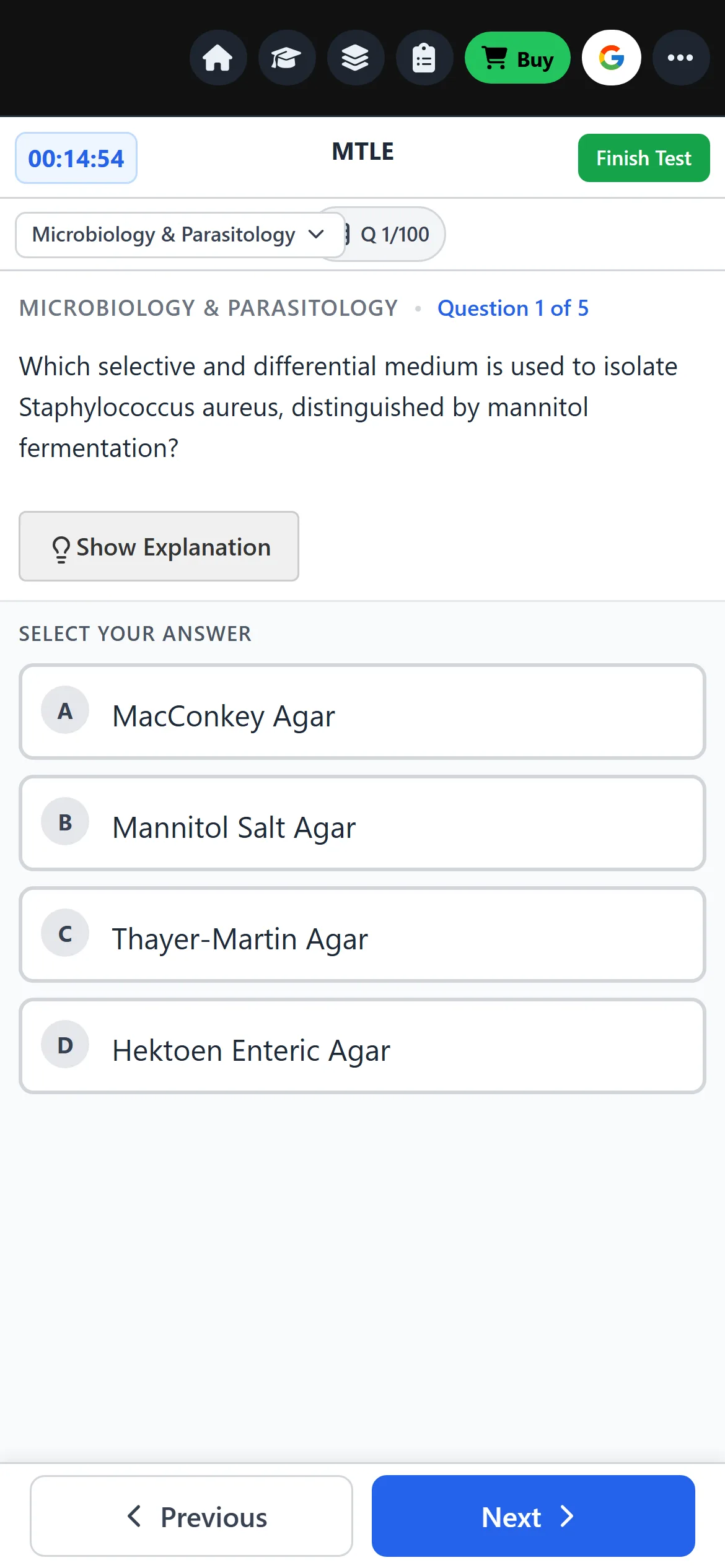
Microbiology and Parasitology looks enormous because the organism list never seems to end. The reassuring part is that the paper rewards structure, not volume. A good microbiology MTLE review turns hundreds of names into a few decision trees, and parasitology into a table of stages. This guide shows how.
Like the other subject guides, it teaches method only: a topic map, how items tend to test each area, and drills. It makes no claim about what any sitting will ask or how often a topic appears.
Why does this paper reward structure?
Microbiology and Parasitology carries 20% of the rating under the weights in RA 5527, the Philippine Medical Technology Act of 1969, and it is a single major subject for the purpose of the 50% floor. A recent PRC program as relayed by Exams Pinas places it second on Day 1, from 11:00 to 1:00, after Clinical Chemistry and before lunch for most reviewees.
Items in this subject tend to describe a specimen, a stain, a culture or a clinical picture and ask you to narrow down an organism or choose the next step. That is a decision-tree skill. Reviewees who study as a list know the organisms but cannot move from clue to name. Reviewees who study as a flow can. The rest of this guide is built on that difference.
How should you study bacteriology for microbiology MTLE items?
Study bacteria by group first, then by the one or two tests that split each group. Start with the Gram stain and the shape: Gram-positive cocci, Gram-negative cocci, Gram-positive rods, Gram-negative rods, and the organisms that stain poorly or not at all.
Inside Gram-positive cocci, the first split is catalase: positive points you to the staphylococci, negative to the streptococci and related genera. Staphylococci then split on coagulase. Streptococci split on haemolysis pattern, with further tests such as bacitracin or optochin susceptibility, bile solubility and the CAMP reaction in specific organisms. Gram-negative rods start with oxidase and whether the organism ferments lactose, then move into sugar fermentation, gas, hydrogen sulphide and the biochemical panel.
Make one page per group with the same four lines: what you see, the splitting test, the usual sites of infection and one classic pitfall. Pitfalls matter because items often ask what looks like one organism but is another.
What identification tests deserve your drilling time?
Drill the tests that split groups, and learn them as pairs of reagent and reaction. A short list covers a large share of routine identification logic:
| Group | Key identification clues | Drill |
|---|---|---|
| Gram-positive cocci | Catalase, coagulase, haemolysis, bacitracin and optochin | Sort ten organisms into a tree |
| Gram-negative rods | Oxidase, lactose on MacConkey, TSI slant reactions, indole, citrate, urease | Read five TSI results aloud |
| Neisseria and related | Oxidase positive, carbohydrate utilisation, selective media | Match the organism to its specimen |
| Anaerobes | Atmosphere, specimen choice, gas-liquid clues | List which specimens are unsuitable |
| Mycobacteria | Acid-fast staining, slow growth, safety handling | State the stain, then the medium |
| Mycoplasma and obligate intracellular | Not seen on Gram stain, special needs | Make a one-line card each |
Media and stains deserve their own page. Know the difference between selective, differential and enrichment media, and write one organism for each example. That single distinction recurs in many items, and it is easy to practise on a phone between other tasks.
How much mycology and virology do you need?
You need the core ideas of mycology and virology in short, firm blocks, not a full course. In mycology, learn the main split between yeasts, moulds and dimorphic fungi, then the superficial, cutaneous, subcutaneous and systemic categories. Know the microscopy clues for the commonest examples and the stains and mounts used to see them. For Candida, know why the germ tube test is useful. For the dimorphic fungi, remember the mould-at-room-temperature, yeast-at-body-temperature idea.
In virology, organise by genome type and by disease. Learn which viruses are enveloped and why that matters for survival outside the body. Then learn the laboratory side: what is detected by culture, by antigen tests, by antibody tests and by molecular methods.
Treat both as a layer on top of the bacteriology tree. Fifteen minutes a day for a week will give you more than a weekend block, because the terms are unfamiliar and need repetition.
How do you remember parasite life cycles and diagnostic stages?
Remember parasites with a three-column table: infective stage, diagnostic stage and specimen. Most life-cycle items reduce to one of those three. Add a fourth column for the route of infection, and a fifth for one classic clinical point.
Take Ascaris as an example. Humans swallow the embryonated egg, which is the infective stage. The diagnostic stage in stool is the egg, so the specimen is stool. Hookworm differs: the infective stage is the filariform larva, which penetrates the skin, and the diagnostic stage in stool is the egg. For pinworm, the egg is the diagnostic stage too, but the specimen is a perianal swab, such as the cellulose tape method, because the female lays eggs outside the anus.
Sort parasites into protozoa (intestinal, blood and tissue), nematodes, trematodes and cestodes. Note which have intermediate hosts and which are shown on a blood film. Then use flashcards on stages, since a card either triggers the answer or reveals the gap.
How do you handle specimens, culture and safety questions?
Handle these items by following the specimen from collection to result, because each step has a rule and each rule is testable. Start with collection: the right container, the right time, the right site, and the reason a poor specimen gives a misleading result. A sputum sample full of squamous cells is saliva, not lung. A urine culture left standing at room temperature overgrows.
Then follow processing: which media a specimen goes on, which atmosphere it is incubated in, and how long a plate is held before it is called negative. Selective media suppress some organisms, differential media show a biochemical difference, and enrichment media let a few cells of a fastidious organism grow. Learn one example of each and say why it fits.
Finish with safety and quality: biosafety levels, handling of cultures, disinfection and waste. Items in this area are short and reward clean definitions. They also overlap with the quality control topics you meet in Clinical Chemistry, so one list of principles will serve both.
Finally, add antimicrobial susceptibility basics: what a zone of inhibition shows, what a minimum inhibitory concentration is, and why a result is reported as susceptible, intermediate or resistant. Keep these ideas short and precise, and revisit them weekly.
What does a two-week block look like?
A two-week block alternates organism work with parasitology so each stays fresh. Use the product's board-length practice sets of 100 items when you want a full paper, and shorter themed groups of items on other days. The bank holds five sets for each subject.
| Days | Bacteriology and others | Parasitology |
|---|---|---|
| 1-2 | Gram-positive cocci tree | Intestinal protozoa |
| 3-4 | Gram-negative rods and TSI | Nematodes and their specimens |
| 5 | Neisseria, anaerobes | Trematodes and cestodes |
| 6-7 | Rest and flashcards | Rest and flashcards |
| 8-9 | Mycobacteria, media and stains | Blood and tissue protozoa |
| 10-11 | Mycology and virology | Mixed life-cycle drills |
| 12 | Timed set of 100 | Review the misses |
| 13-14 | Write rules for each miss | Re-test the weakest group |
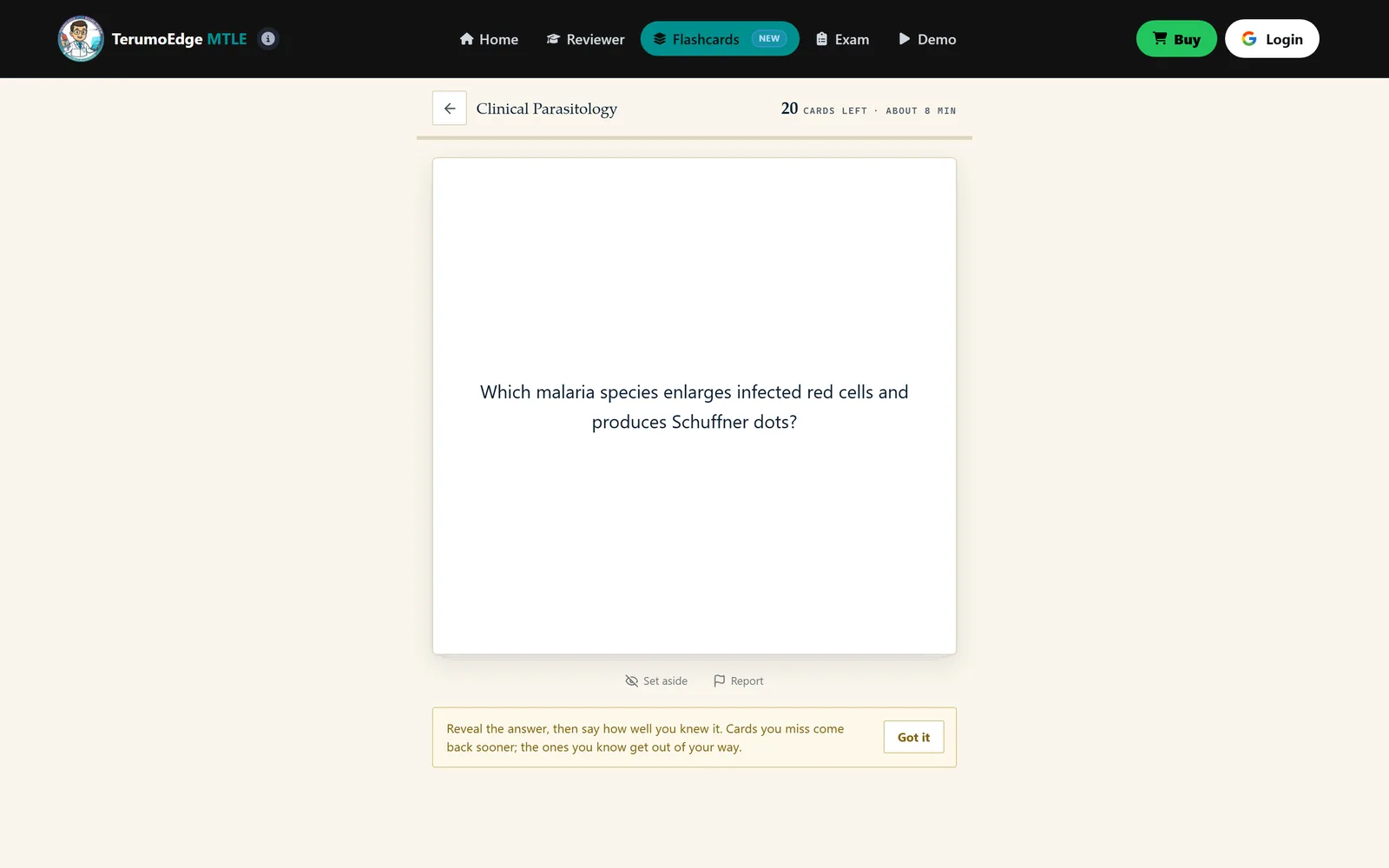
Pair it with the flashcards and the visual reviewer at /learn/ for mechanisms. The 10% papers still need a slot, so see Clinical Microscopy and Histopath, and place the whole block in your study plan. The free demo lets you try five items in this paper, so you can see how an explanation walks through the clue-to-organism flow.
Frequently asked questions
How heavy is Microbiology and Parasitology on the MTLE?
Microbiology and Parasitology carries 20% of the board rating under the weights in RA 5527. It shares that weight with Clinical Chemistry, Hematology, and Blood Banking and Serology. Clinical Microscopy and Histopathologic Technique carry 10% each. The 50% floor applies to this paper like any other major subject.
How do I remember parasite life cycles?
Reduce each parasite to infective stage, diagnostic stage, specimen and route of infection, then repeat those four cells on spaced flashcards. Draw a loop only for the few parasites with intermediate hosts. Drawing every cycle in full takes time you will not recover, and a table is easier to recall under a clock.
Are image items common in this paper?
No source we rely on states how often any sitting uses images, so make no assumption. Prepare for both: learn the textual clues for an organism and also practise with stained smears, colony descriptions and egg or larva images. Both skills help whichever way an item is written.
What if Microbiology is my weakest paper?
Start it earlier, keep sessions short and daily, and track your score by group rather than overall. Because of the statute's 50% floor in each major subject, a weak paper is a risk that more study in other subjects cannot offset. See the passing rules.
Sources
From the publisher
Meet the MTLE here first.
TerumoEdge MTLE is an MTLE simulator: board-length practice sets in all six board subjects, sat on a clock, with a full explanation for every item instead of a bare answer key.
- 3,000 items across the six MTLE board subjects, 500 in each
- five board-length sets of 100 items per subject
- A full explanation for every item, not a bare answer key
- A visual reviewer and flashcards beside the question bank
Try the free MTLE simulator demo Five real items per board subject. No account needed.
About this article
Written by the TerumoEdge editorial team, who build the TerumoEdge MTLE Ex-Sim. Exam facts are checked against RA 5527, the Philippine Medical Technology Act of 1969, Professional Regulatory Board of Medical Technology resolutions and PRC announcements, and every article lists its sources. How we write and check our articles.
First published .