
Your situation7-minute readFor MTLE retakers
MTLE retaker? A plan that changes the result next sitting
An MTLE retaker plan: find out whether you missed the 75% average or the 50% floor, diagnose the cause, and build a 10-week plan around it.
If you are an MTLE retaker, the result probably still stings, and that is a reasonable thing to feel. Many graduates who later pass did not on the first try. This post does not guess at your reasons or offer statistics about repeaters. It gives you a way to work out what actually cost you, and then to build a plan around that cause so the next sitting is a different experience, not a longer version of the last one.
Give yourself a few days to rest, then come back to this with a notebook. If you are still deciding how to prepare, the 12-week study plan and the results guide give useful context.
What should an MTLE retaker do first?
An honest debrief asks what happened, not who is to blame, and it starts with the facts on your result. Write down what you know: how you felt in each paper, which subjects you finished late, which ones you left blank or rushed, and what your result showed. Do this while memory is fresh, before it turns into a story.
Then separate three things that blur together after bad news. Content gaps are topics you did not know. Execution problems are things like pacing, misreading stems and fatigue. Method problems are how you reviewed, such as reading without testing yourself. A retaker who treats all failure as "I need to study more" will repeat the same review. A retaker who finds the specific cause can change something real.
Which part of the pass rule did you miss?
Start with the rule itself. The statute, RA 5527, requires a general average of at least 75% in the written test, with no rating below 50% in any of the major subjects. You can miss it in two different ways, and they call for different plans.
If your general average fell short, your whole profile needs lifting, and the weights tell you where the points are: Clinical Chemistry, Microbiology and Parasitology, Hematology, and Blood Banking and Serology carry 20% each, and the other two papers carry 10% each. If one subject came in under 50%, the average may not be your main problem at all. A single weak paper can fail you, however well the others went.
| What happened | What it means | Where to focus first |
|---|---|---|
| General average below 75%, no subject under 50% | Broad shortfall | The four 20% subjects, then the rest |
| One subject below 50% | A floor problem | That subject, even if it is only 10% |
| Both | Broad and specific gaps | The floor subject first, then the heavy subjects |
| Not sure | You lack the detail | Rebuild a baseline with timed sets |
Check what your result slip and PRC records show. If you cannot see subject ratings, take a timed baseline in all six subjects to find the weak ones.
What are the 70% route and the refresher rule?
Two rules matter to a retaker, and neither should frighten you. First, PRC results announcements state that those below passing with a general rating of at least 70% may register as a Medical Laboratory Technician. That is a separate registration, not the same as passing, and the details are in the Medical Laboratory Technician guide. Confirm the process and scope with PRC.
Second, the statute says no further examination will be given to an applicant who has not qualified after three examinations, unless a 12-month refresher course in an accredited medical technology school, or 12-month postgraduate training in an accredited laboratory, has been completed. Count your attempts and check your standing.
No source here says you can retake only part of the exam or carry over a passed subject. Do not plan on it. Ask PRC what applies to you. The passing score guide explains the rule in full.
How do you diagnose the cause of the shortfall?
Diagnose the cause by matching what you saw in the exam to one of a few common patterns, then test your guess with timed practice. A guess you never test is just another story. Use the table as a checklist, and answer honestly.
| Diagnosis | Sign | Fix |
|---|---|---|
| Content gap | You did not recognise the topic at all | Rebuild that topic from first principles, then drill it |
| Recall problem | You recognised it but could not retrieve the answer | Replace rereading with flashcards and timed items |
| Pacing | Late papers felt rushed or unfinished | Practise checkpoints on timed, board-length sets |
| Misreading | You knew it but chose the wrong option | Slow the stem, underline the question word, review misses |
| Skipped small subjects | A 10% paper dragged you down | Give both 10% papers a weekly block |
| Fatigue and nerves | Day 2 went worse than Day 1 | Rehearse two-day stamina and a reset routine |
Most retakers find two causes, not one. Pick the top two and build your plan around them. A visual reviewer such as the /learn/ reviewer can help rebuild concepts, and flashcards suit recall.

What does a 10-week retaker plan look like?
A 10-week plan fixes the diagnosed causes first, then rehearses the full exam. It assumes you start roughly ten weeks before your sitting, so adjust the dates to your own. The method changes: you test yourself in every week, and every error goes into a notebook with a fix.
| Weeks | Focus | Output |
|---|---|---|
| 1 | Baseline: one timed set in each subject, debrief lists | A ranked list of weak subjects |
| 2-4 | Fix the floor subject and the top two weak 20% subjects | Topic notes, flashcards, timed blocks |
| 5-6 | Remaining subjects, plus both 10% papers weekly | Mixed timed sets, mistake notebook review |
| 7-8 | Full board-length papers with the real clock | Pacing checkpoints, execution fixes |
| 9 | Two-day rehearsal, six papers over two days | Stamina data, reset routine tested |
| 10 | Taper: light recall, sleep, logistics | Calm arrival |
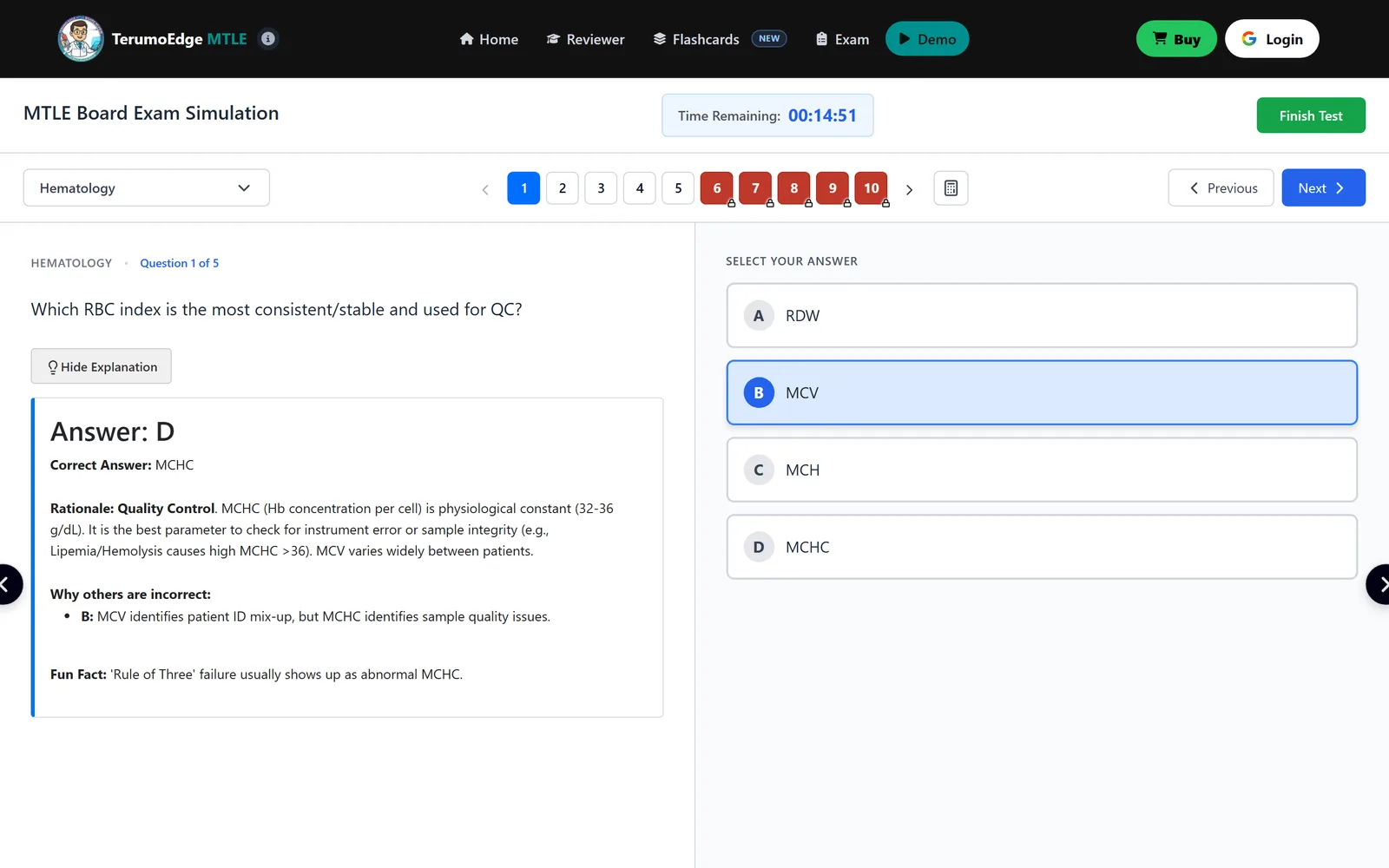
TerumoEdge, which publishes this blog, is a simulator, so weigh this accordingly. It offers five board-length sets of 100 items per subject with an explanation for every item, and a free demo lets you check the style first. Whatever tool you use, the habit is to read the explanation for every miss.
How do you keep your mind steady during a second attempt?
Keep your mind steady by treating the second attempt as a project with a method, not a verdict on you. Retakers often carry extra pressure: family questions, a fear of repeating the result and a sense that time is running out. That pressure can shrink the very practice you need.
Set small weekly goals that you control, such as a number of timed sets and a review of every miss, instead of goals you do not control, such as a rating. Keep sleep and meals regular, and take one real rest day each week. Tell one trusted person your plan, so you are not carrying it alone.
If dread or low mood begins to disrupt sleep, eating or daily life, talk to a qualified professional. Preparation is easier when you are well.
Frequently asked questions
Do I have to retake all six subjects?
The sources used here do not describe any partial retake or carry-over of passed subjects, so do not assume one. Plan to prepare for all six papers, and ask PRC directly what applies to your case. Even if only one subject was the problem, the general average still counts every paper.
How many times can I retake the MTLE?
The statute states that after three failed examinations, no further examination is given until you complete a 12-month refresher course in an accredited medical technology school or 12-month postgraduate training in an accredited laboratory. Requirements can differ by background, so confirm your standing and any recent changes with PRC before filing.
Should I change my review center?
Change it if your diagnosis points to it, not out of frustration. If the issue was recall and timed practice, a new center with the same lectures may not help. If you had no structure, a cohort might. Choose the setup that fixes your top two causes, and keep it for the whole period.
Does a 70% rating mean I passed?
No. PRC announcements say that those below passing with a general rating of at least 70% may register as a Medical Laboratory Technician. That is a different registration from passing the MTLE. See the guide linked above and confirm the process with PRC.
Sources
From the publisher
Meet the MTLE here first.
TerumoEdge MTLE is an MTLE simulator: board-length practice sets in all six board subjects, sat on a clock, with a full explanation for every item instead of a bare answer key.
- 3,000 items across the six MTLE board subjects, 500 in each
- five board-length sets of 100 items per subject
- A full explanation for every item, not a bare answer key
- A visual reviewer and flashcards beside the question bank
Try the free MTLE simulator demo Five real items per board subject. No account needed.
About this article
Written by the TerumoEdge editorial team, who build the TerumoEdge MTLE Ex-Sim. Exam facts are checked against RA 5527, the Philippine Medical Technology Act of 1969, Professional Regulatory Board of Medical Technology resolutions and PRC announcements, and every article lists its sources. How we write and check our articles.
First published .