
Comparisons7-minute readFor graduates studying from handouts and PDFs
MTLE reviewer PDFs vs a simulator: which one moves your score
A fair comparison of an MTLE reviewer in PDF form and an MTLE simulator: what each trains, where each stops and how to combine them.
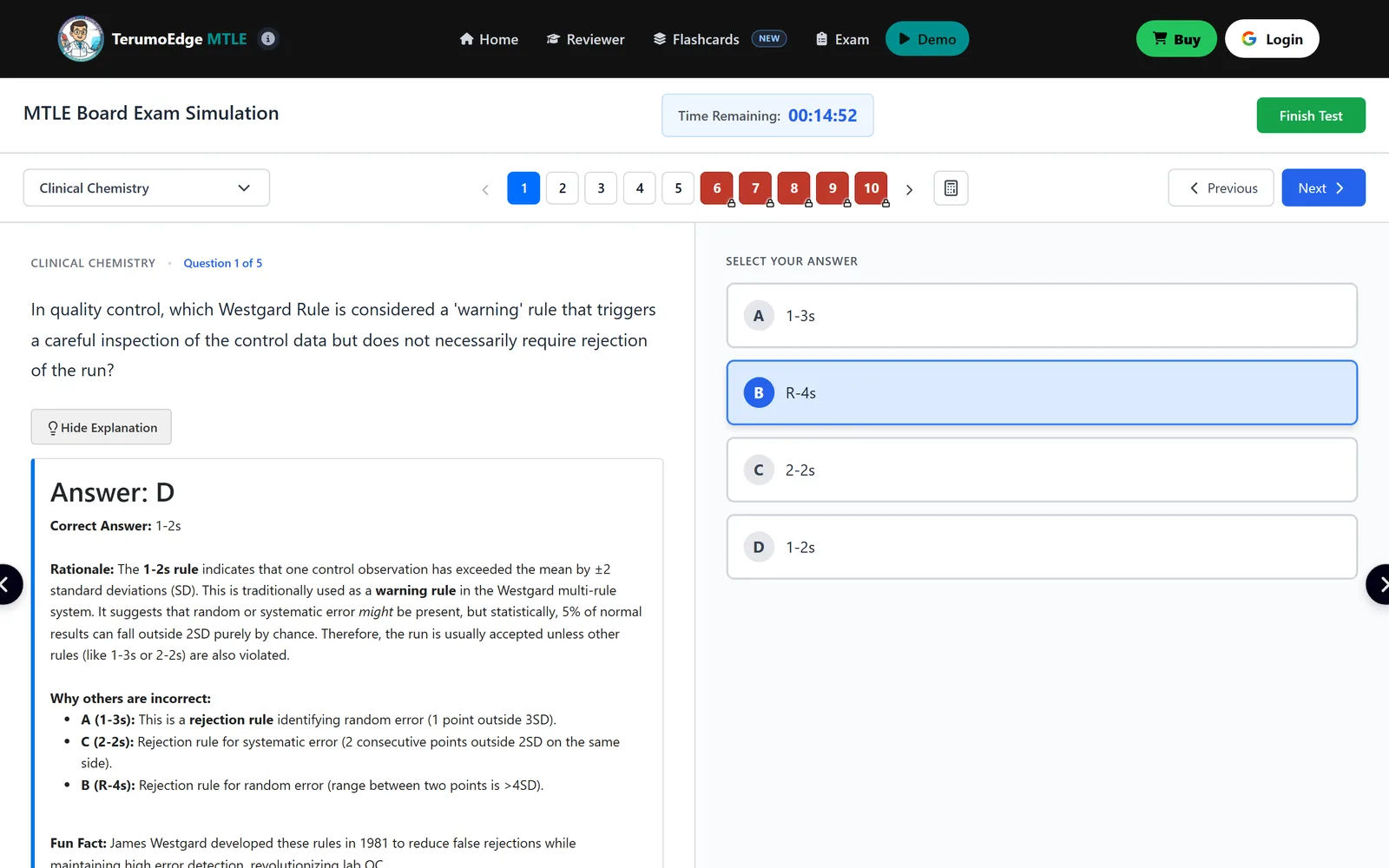
If you are reviewing from handouts and an MTLE reviewer in PDF form, you probably have more material than time. The real question is not which resource is better, but which job each one does. This post compares the two honestly, by category, and shows how to use both without doubling your workload.
TerumoEdge, which publishes this blog, makes a simulator. We have tried to credit what reviewers do well, because a simulator without content knowledge behind it is just a way to fail quickly.
What is the short answer?
PDFs and handouts build coverage, and a simulator tests it. Use a reviewer to learn what the six subjects contain, then use timed questions to find out what stuck. If you only read, your score tells you nothing until the exam. If you only practise questions with no content base, you will guess.
| Criterion | PDF reviewer or handouts | Simulator |
|---|---|---|
| Builds content coverage | Strong | Weak; it assumes you have studied |
| Tests recall | Only if you self-quiz | Built in |
| Runs on a clock | No | Yes |
| Scores each subject | No | Yes |
| Explains every item | Varies; often an answer key only | Yes, in a good one |
| Fits a quick revision pass | Strong | Moderate |
| Reliable to be current | Depends on the source and date | Depends on the publisher; ask |
The pattern is clear: the two tools cover opposite columns.
What does an MTLE reviewer do well?
PDF reviewers do three things well. They compress a large syllabus into a form you can scan, they let you annotate and revise from them anywhere, and they are easy to share and keep. For first-pass coverage, a good reviewer is hard to beat.
They also give you a map. The statute weights the six subjects at 20, 20, 20, 20, 10 and 10 percent according to Sec. 17 of RA 5527, and a reviewer organised by subject lets you see how much territory each carries.
The honest caveats are about age and quality. Older compilations may carry outdated values or methods, and a reviewer written by one person can contain errors that nobody checked. Cross-check a surprising fact against your textbook before you memorise it.
Where do PDFs stop?
PDFs stop where testing begins. A page cannot time you, score you by subject, or tell you why your wrong answer was attractive. The most dangerous effect is fluency: because you recognise the text on a re-read, you feel you know it, and the feeling is unreliable.
The pass rule makes that gap costly. You need a general average of at least 75%, with no rating below 50% in any major subject. A PDF cannot show you which subject is quietly sliding toward the floor. Only scored practice can.
Many PDF reviewers also include questions with an answer key and no reasoning. A key tells you that the answer is D. It does not tell you why A, B and C fail, and that reasoning is where most of the learning is. You can improve this by writing your own one-line reason for each option you eliminated.
What does a simulator add?
A simulator adds a clock, a score for each subject and an explanation for every item. Each of the three answers a question that a PDF leaves open.
The clock tells you whether your pace works over a full paper. Recent PRC programs, as relayed by a secondary source, run six 2-hour papers over two days, so pace and stamina are real variables. The subject scores tell you where your floor risk lives. The explanations convert each miss into a lesson.
A simulator is also forgiving in the right way. A failed practice set costs you an evening, not a sitting. TerumoEdge holds 3,000 items in five board-length sets per subject, with an explanation for each, and a free demo lets you judge five items per subject before deciding. For the general case, see what an MTLE simulator is.
Which should you use when?
Use the reviewer first and the simulator early, and keep both running to the end. A workable order follows.
- Weeks 1 to 2: read your reviewer by subject, weighted by the 20% papers. Sit one short diagnostic set per subject.
- Weeks 3 to 8: alternate. Read a topic, then answer timed items on it, and read every explanation.
- Later weeks: rehearse full papers on a clock. Use the reviewer only to repair what the simulator exposes.
- Final days: revise from your own error notes and flashcards, not new material.
For pacing a full paper once the content is in place, read MTLE time management. For the weekly structure, see the 12-week study plan. A visual option for content is the reviewer at /learn/.
How do you read a reviewer so the content sticks?
Read a reviewer actively, by turning each heading into a question you must answer before you read the paragraph. Passive reading is the most common reason handouts disappoint.
Try this routine on every topic. Read a section once. Close the file. Write a three-line summary from memory, then check it and correct it. Next, write two questions you think an examiner could ask, and answer them tomorrow. This takes about twice as long as re-reading, and it gives you evidence of what you know.
You can also mark each page with a simple code: green for confident, yellow for shaky, red for lost. Return to the red pages first. When a timed set exposes a weak topic, go back to the matching page and add a note about the exact point you missed.
What does a week with both tools look like?
A week with both tools alternates reading and testing, so every topic is met twice. The table shows one possible week for a reviewee with a few free hours each day.
| Day | Reviewer work | Simulator work |
|---|---|---|
| Mon | Read one 20% subject topic | Short timed block on that topic |
| Tue | Read the next topic | Block on yesterday and today |
| Wed | Repair red pages | Redo missed items |
| Thu | Read a 10% subject topic | Short block on it |
| Fri | Flashcards on the week | Mixed block, timed |
| Sat | Light review only | One full-length timed set |
| Sun | Read the set's explanations | Rest, or redo misses |
Change the subjects to follow your weak papers. The fixed idea is that testing arrives within a day of reading, while the content is still fresh.
Frequently asked questions
Are old MTLE reviewers still useful?
Often, yes, for stable foundations such as methods, morphology and organism identification. Be careful with anything numeric, such as reference ranges or cut-offs, which can differ by lab or edition. Check unfamiliar facts against a current textbook, and treat an undated reviewer as a draft that needs verifying.
Reviewer or questions first?
Reviewer first for a short pass, then questions as early as you can. Questions show you what to read next. Waiting until you have finished every page of every reviewer delays the feedback you need and leaves too little time to fix what it reveals.
How do I test recall from a PDF?
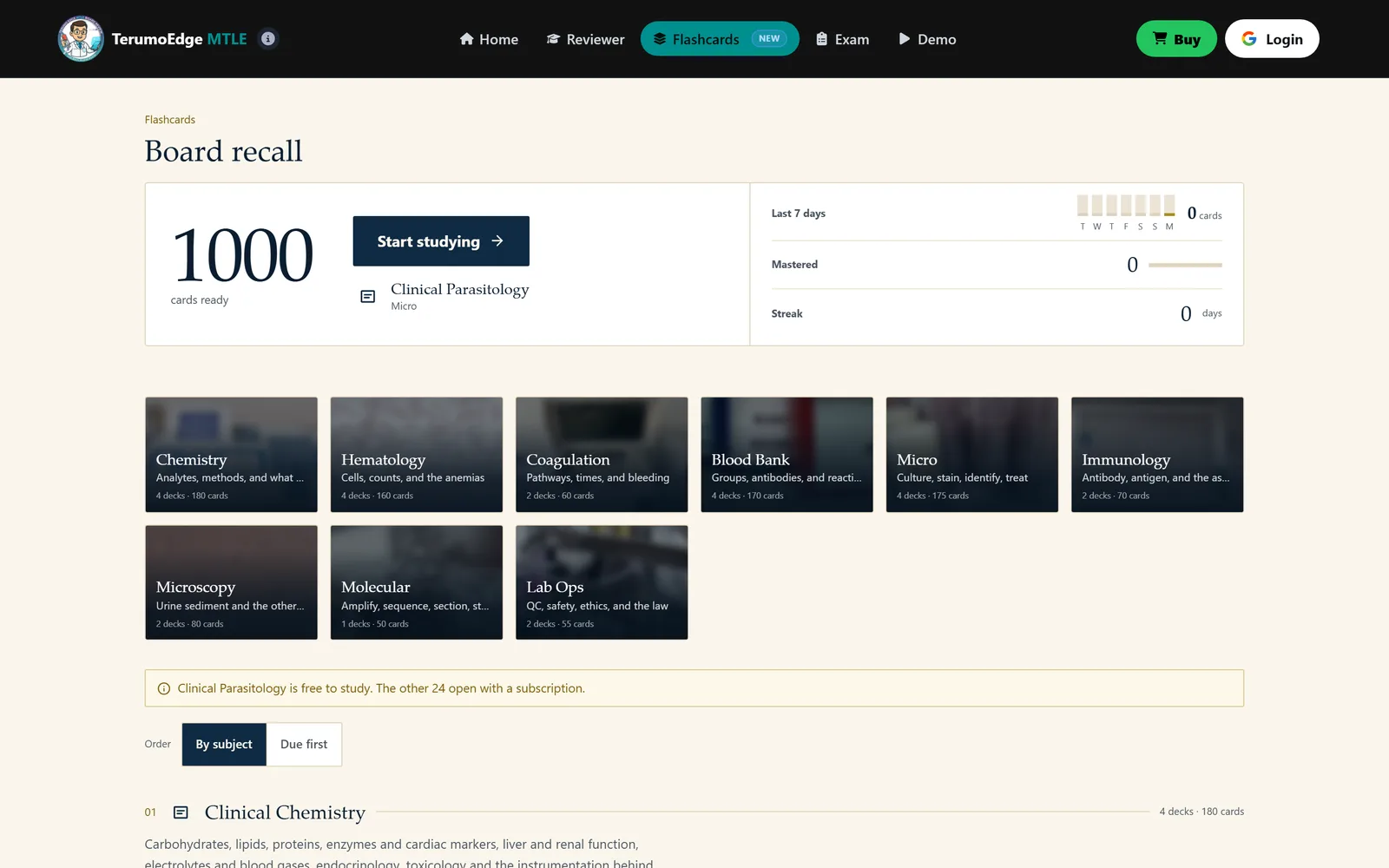
Close the file, then write or say everything you remember about a topic, and compare. You can also convert headings into questions or make flashcards. The point is to retrieve before looking. TerumoEdge also offers 1,000 flashcards at /flashcards/ for the same purpose.
Can a simulator replace my reviewer?
Not for building knowledge from zero. A simulator assumes you have met the content. Its explanations teach as you go, but they are organised around items, not around a syllabus. Most reviewees keep a reviewer for coverage and use the simulator to test it.
Is it worth printing a reviewer?
If you annotate heavily, print the pages you will mark and keep the rest on screen. Paper helps with writing recall answers beside the text and with long sessions away from a device. A phone or tablet is easier to carry and search. Choose the format that gets you to study every day.
Can I share a simulator account like a PDF?
Do not assume you can. A PDF is a copy, while a simulator is usually tied to an account and a licence. Check the terms of any product before you share it, and use the free demo to compare before anyone pays.
Sources
From the publisher
Meet the MTLE here first.
TerumoEdge MTLE is an MTLE simulator: board-length practice sets in all six board subjects, sat on a clock, with a full explanation for every item instead of a bare answer key.
- 3,000 items across the six MTLE board subjects, 500 in each
- five board-length sets of 100 items per subject
- A full explanation for every item, not a bare answer key
- A visual reviewer and flashcards beside the question bank
Try the free MTLE simulator demo Five real items per board subject. No account needed.
About this article
Written by the TerumoEdge editorial team, who build the TerumoEdge MTLE Ex-Sim. Exam facts are checked against RA 5527, the Philippine Medical Technology Act of 1969, Professional Regulatory Board of Medical Technology resolutions and PRC announcements, and every article lists its sources. How we write and check our articles.
First published .