
Guides7-minute readFor medtech graduates preparing for the MTLE
What an MTLE simulator is, and why reading reviewers isn't enough
What an MTLE simulator is, what it reproduces from the board exam, and how it differs from a reviewer or a review center. Includes a free demo.
You have finished your degree and your internship, and now you own a stack of handouts, a few PDF reviewers and maybe a review center schedule. The question is how to find out whether any of it is working. An MTLE simulator answers that question with a score, a clock and an explanation, and this post explains what it is, what it should reproduce and how it fits beside the materials you already have.
TerumoEdge, which publishes this blog, makes a simulator, so weigh what follows accordingly. We have tried to be fair to reviewers and review centers, because a good review usually uses all three.
What is an MTLE simulator?
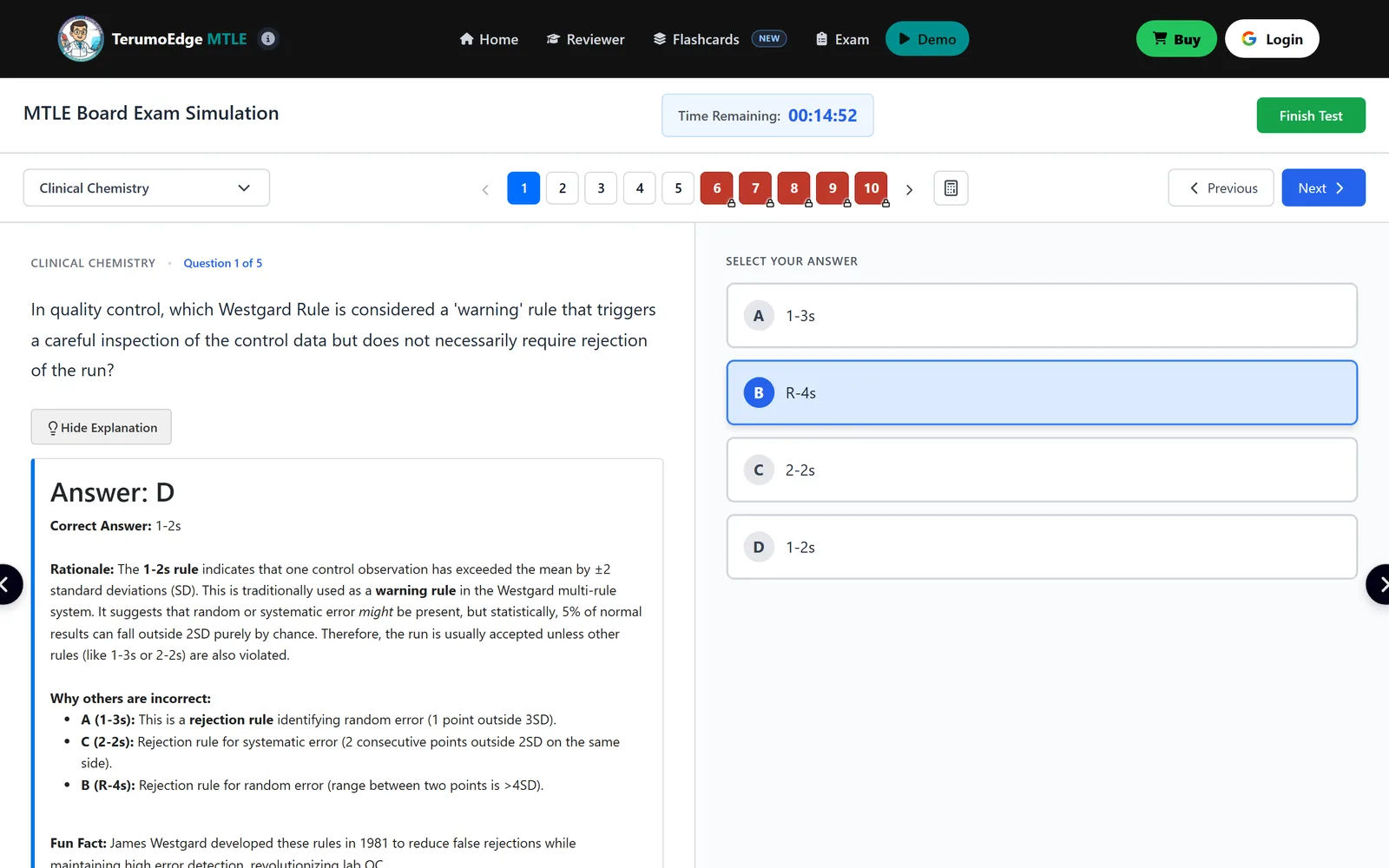
An MTLE simulator is a practice environment that copies the conditions of the board exam, not just its topics. You choose a subject, sit a full-length set under a countdown, answer items without notes, finish, and then see your score and the reasoning behind every item.
Three features separate a simulator from a question list. First, it is timed, so pace becomes something you can measure. Second, it is scored by subject, so you see your standing the way the rating rule sees it. Third, it explains every item, so a wrong answer becomes a lesson instead of a red mark.
A simulator is not a lecture. It does not replace the teaching that builds content knowledge. Its job is to test what you took in and show you, honestly, where the gaps are while there is still time to fix them.
Why does the MTLE reward rehearsal?
The MTLE rewards rehearsal because it is a long, structured sitting with a pass rule that punishes uneven preparation. Under Sec. 19 of RA 5527, the Philippine Medical Technology Act of 1969, you need a general average of at least 75% in the written test, with no rating below 50% in any of the major subjects.
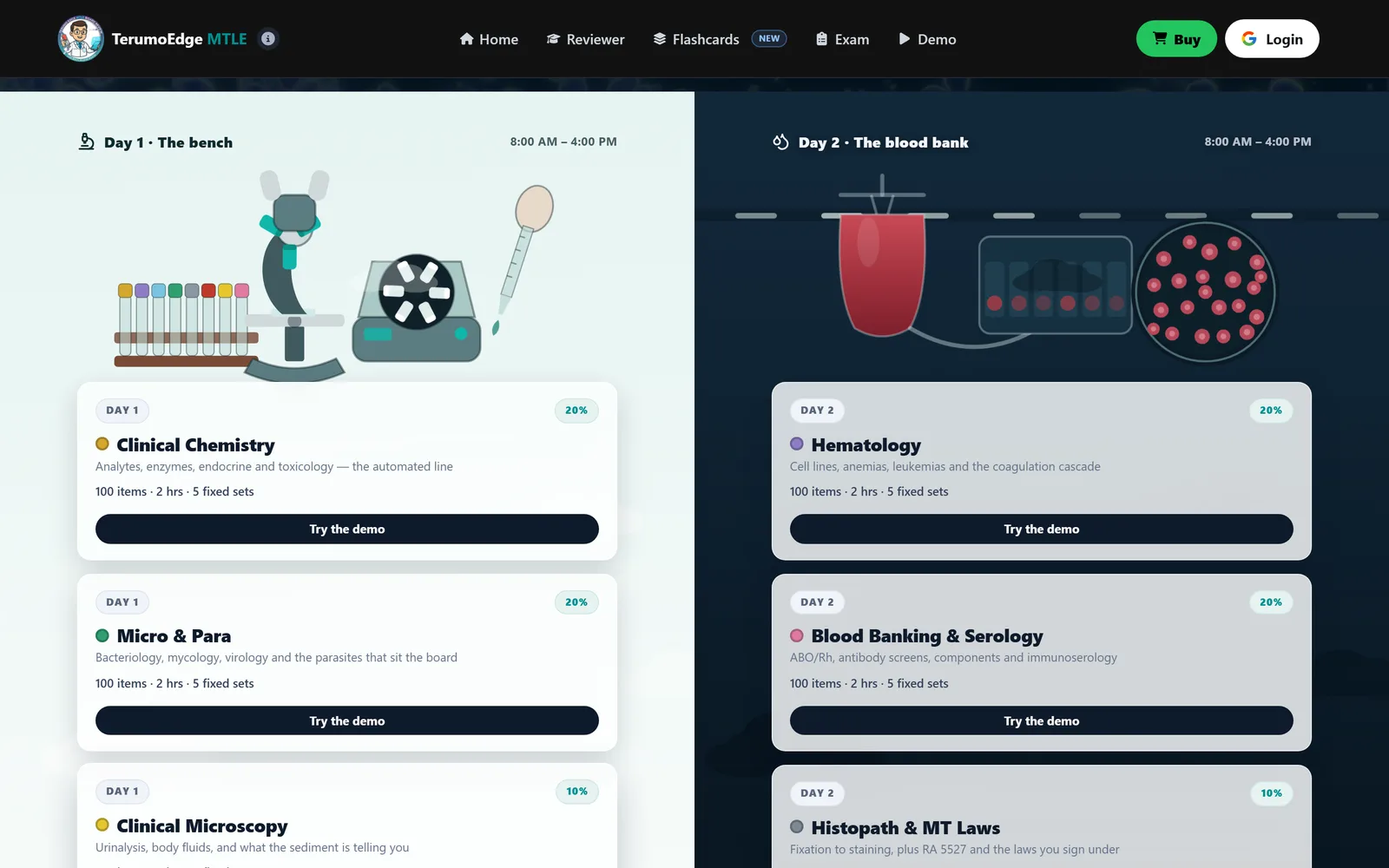
Recent PRC programs, as relayed by a secondary source, arrange the exam as six 2-hour papers over two days, from 8:00 AM to 4:00 PM. That is twelve hours of exam time. Stamina is a skill, and you cannot build it by reading.
The two-part rule also means a strong subject cannot rescue a collapsed one. A reviewee who breezes through Clinical Chemistry but sits Histopathology cold can fail on the floor alone. Rehearsal under realistic conditions is how you find that out in October instead of on results day.
What should a good simulator reproduce?
A good simulator reproduces the structure of the sitting, the weighting of the subjects and the pressure of the clock. Check it against this table before you trust it.
| Feature | Why it matters for the MTLE | What to look for |
|---|---|---|
| All six subjects | Every major subject carries a 50% floor | A separate paper for each, not one mixed pool |
| Board-length sets | Pace and stamina only appear at full length | A set you can finish in about two hours |
| A visible countdown | Pace is half of performance | A running timer you cannot pause |
| Subject weights | Weights are 20, 20, 20, 20, 10 and 10 per the statute | Practice volume that follows the weights |
| Explanations for every item | Learning happens after the answer | Why the right option is right and the others are wrong |
| Per-subject scores | The floor is applied per subject | A score for each paper, not one total |
TerumoEdge designs its own sets at 100 items each. That is a design choice of this product and not a statement about the length of PRC's papers, which PRC announcements do not give.
How is a simulator different from a reviewer or a review center?
A simulator tests and explains, a reviewer supplies content, and a review center supplies teaching and structure. Each trains something different, and none of them does the other two jobs well.
| Tool | Mainly trains | Weak point | Best used for |
|---|---|---|---|
| Review center | Content and routine, through lectures and a cohort | Mock exams vary in length and explanation depth | Building the knowledge base and a schedule |
| PDF reviewer or handouts | Coverage and quick reference | Reading feels like learning without testing recall | First-pass coverage and revision notes |
| Simulator | Recall, pace and stamina under a clock | It does not teach a subject from zero | Finding gaps and rehearsing the sitting |
| Flashcards | Spaced recall of facts | Facts without application | Daily short sessions |
The honest summary is that content comes first and testing comes second, but testing must start early. If you want the detailed comparison, read MTLE reviewer PDFs versus a simulator.
What does TerumoEdge include?
TerumoEdge MTLE Ex-Sim holds 3,000 items across the six board subjects, with 500 in each subject. Each subject has five board-length sets of 100 items, run on a countdown. Every item has an explanation that covers the correct answer and the reasons the other options fail.
Beside the question bank there is a visual reviewer at /learn/ and a flashcard hub at /flashcards/ with 1,000 cards. The paper picker is laid out as Day 1 and Day 2, so the order of your practice can follow the order of the real sitting.
You can try five free items per board subject in the free demo, with no account. Use it to judge the explanations and the feel of the clock before you decide anything. Pricing lives on the buy page, and we do not quote it here because it changes.
How should you use a simulator across your review?
Use the simulator in three phases: short diagnostics early, subject blocks in the middle, and full rehearsals near the end. The aim is to move from finding gaps to proving stamina.
In the first weeks, sit one set in each subject to see where you stand, then read every explanation, including those for items you got right. In the middle weeks, work through subject blocks in proportion to the weights, and redo the items you missed after a gap of a few days. In the final weeks, sit one Day 1 and Day 2 pair of papers back to back, on the real timetable.
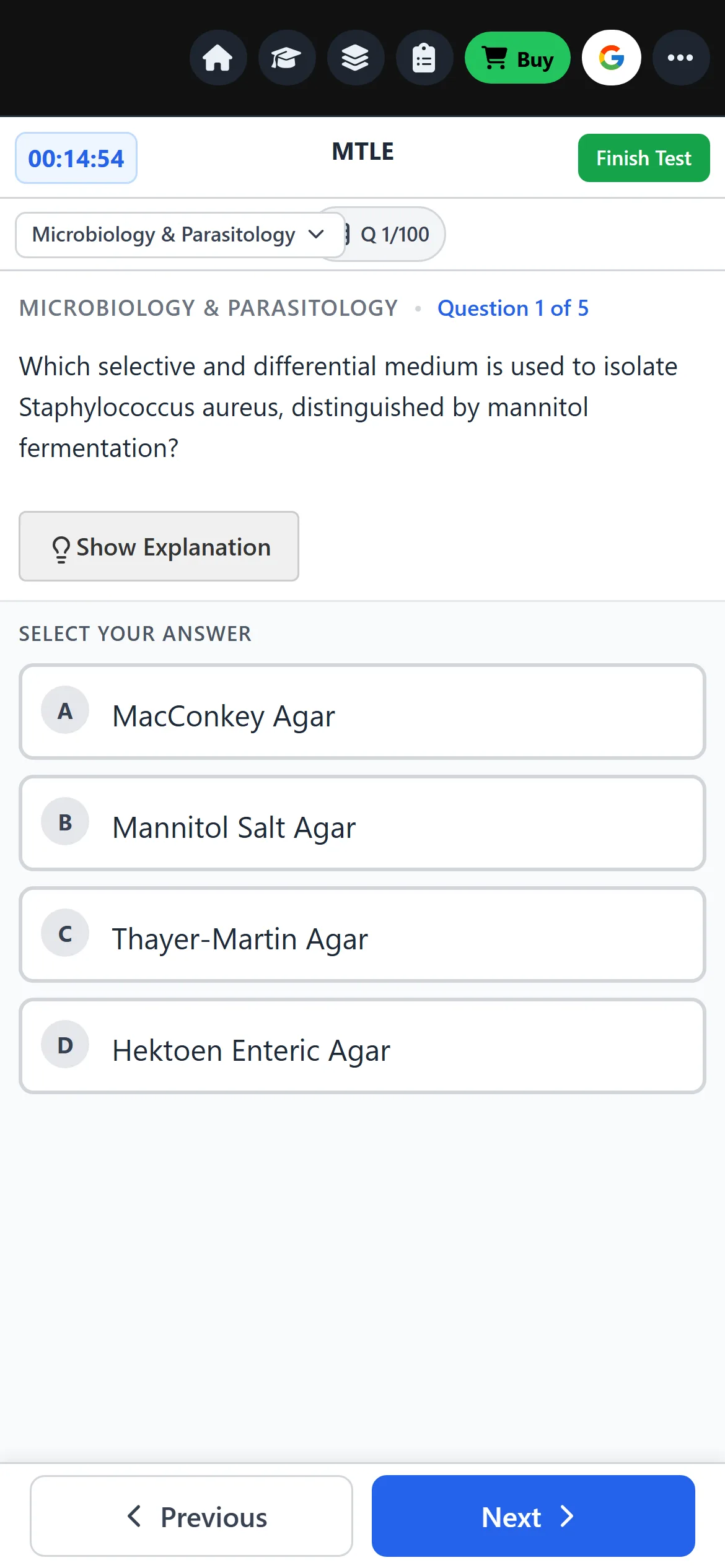
A phone is fine for short blocks on a commute. Save the full sets for a desk, because the real papers are two hours of sitting still. For a week-by-week structure, see MTLE time management and the six subjects and their weights.
What does an MTLE simulator not do?
An MTLE simulator does not teach a subject from scratch, predict your rating or reproduce the exact papers PRC sets. Knowing these limits helps you use it well.
It cannot show you the real items, because PRC does not publish them, and no honest simulator claims to. What it can do is reproduce the conditions: the six-subject structure, a clock, items written in the board style and a score for each paper. It also cannot stand in for a conversation with a lecturer who watches you think.
The practical rule is to treat the simulator as a measuring instrument. A measurement is only useful if you act on it. After each set, list the topics you missed, return to your reviewer or lecture notes for those topics, and then test them again a few days later. That loop of test, repair and retest is where a score actually changes.
Frequently asked questions
Is there a free MTLE simulator?
TerumoEdge offers a free demo with five items per board subject and no account needed. It uses the same exam room as the full simulator, so you can judge the clock, the layout and the explanations. The full question bank is a paid product; see the buy page for current details.
Can a simulator replace a review center?
No. A review center teaches content and gives you a routine and a cohort. A simulator tests recall and pace and explains what you missed. Many reviewees use both, and a self-reviewer who already has strong content can lean mostly on a simulator and reviewer notes.
How many practice items should I do?
There is no sourced number. A workable rule is to cover every subject at least once as a diagnostic, spend more sets on the 20% subjects and any subject near your 50% floor, and finish with full two-day rehearsals. Quality counts more than volume: reading every explanation matters more than a long tally.
Does the MTLE use a computer or paper?
PRC announcements do not state a computer-based format, and we do not claim either way. Practise the skills that hold in any format: pacing, careful reading and answering without notes. Read your own PRC program for the format and rules of your sitting.
Sources
From the publisher
Meet the MTLE here first.
TerumoEdge MTLE is an MTLE simulator: board-length practice sets in all six board subjects, sat on a clock, with a full explanation for every item instead of a bare answer key.
- 3,000 items across the six MTLE board subjects, 500 in each
- five board-length sets of 100 items per subject
- A full explanation for every item, not a bare answer key
- A visual reviewer and flashcards beside the question bank
Try the free MTLE simulator demo Five real items per board subject. No account needed.
About this article
Written by the TerumoEdge editorial team, who build the TerumoEdge MTLE Ex-Sim. Exam facts are checked against RA 5527, the Philippine Medical Technology Act of 1969, Professional Regulatory Board of Medical Technology resolutions and PRC announcements, and every article lists its sources. How we write and check our articles.
First published .