
Study strategy7-minute readFor reviewees tackling Hematology and Blood Banking
Hematology MTLE review with Blood Banking: two 20% papers, one plan
Plan your hematology MTLE review with blood banking and serology: morphology by pattern, hemostasis pathways, compatibility logic and a two-week block.
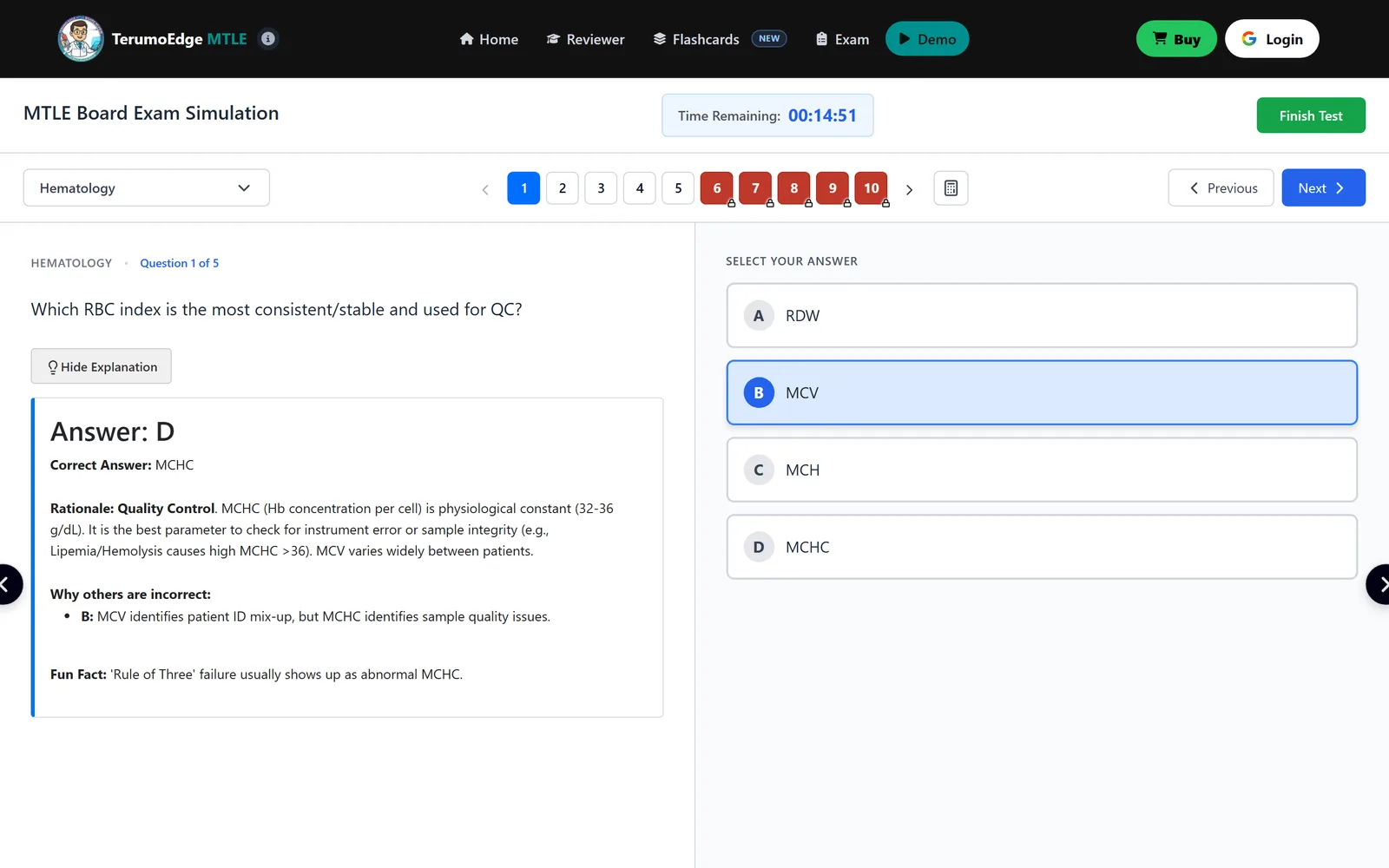
Two of the six MTLE papers sit in this guide, and they make up 40% of the weights. If you are searching for a hematology MTLE review plan, you are in the right place, and you probably already sense that Hematology and Blood Banking and Serology are the subjects where the same ideas keep returning: cells, antigens, antibodies and clots. That overlap is good news, because one clear diagram helps in more than one place.
This guide covers method only. It lays out the topic map, how items tend to test each area, and drills. It makes no claim about what any sitting will ask.
How much of your rating do Hematology and Blood Banking carry?
Hematology carries 20% and Blood Banking and Serology carries 20%, according to the weights in RA 5527, the Philippine Medical Technology Act of 1969. Combined, they equal the same share as Clinical Chemistry and Microbiology and Parasitology put together. A recent PRC program as relayed by Exams Pinas places both on Day 2, Hematology from 8:00 to 10:00 AM and Blood Banking and Serology from 11:00 to 1:00 PM, so you will face them back to back after a night of rest.
The statute also demands a general average of at least 75% and no rating below 50% in any major subject. So neither can be the paper you hope to cover with a strong score elsewhere. The passing score and rules post explains the arithmetic.
How should you approach hematology MTLE items on morphology and counts?
Learn morphology as a pattern in four columns: size, colour, shape and inclusions. Then attach a cause to each pattern. Microcytic hypochromic cells point you towards iron deficiency, thalassemia trait, sideroblastic changes or chronic disease. Macrocytic cells make you ask about vitamin B12, folate, liver disease or drugs. A target cell, a sickle cell or a schistocyte each tells a story you can name in one line.
Counts and indices are the arithmetic half. Know how the red cell indices are derived and what each tells you. For instance, mean cell volume is the haematocrit divided by the red cell count, scaled by ten. A haematocrit of 36% with a red cell count of 4.5 x 10^12/L gives 80 fL.
For white cells, learn maturation sequences in order and the "left shift" idea. Then drill with a blood-film image bank and say the pattern aloud.
How do you handle hemostasis and coagulation?
Hemostasis becomes manageable once you draw the pathways one time and let them do the reading. Draw the intrinsic and extrinsic arms joining into the common pathway, mark the factors in each arm, and colour the vitamin K dependent ones. Then attach the screening tests: the prothrombin time follows the extrinsic and common pathways, and the activated partial thromboplastin time follows the intrinsic and common pathways.
From that single diagram, you can read results. A prolonged PT with a normal aPTT points to the extrinsic arm. A prolonged aPTT with a normal PT points to the intrinsic arm. Both prolonged points to the common pathway or to multiple deficiencies. Add the platelet side: count, function, and what a bleeding time or platelet function test is meant to show.
Do not leave out anticoagulant therapy. Know which test monitors which drug, and why. Items often ask which test fits a patient on a given anticoagulant, and a short table settles that question for good.
What is the logic of blood banking?
Blood banking is logic, so write the antigens and antibodies on the page before you pick an answer. Start with ABO: each group carries antigens on the red cells and the opposite antibodies in the plasma. A group A recipient has anti-B, so group B red cells would be attacked. Then add Rh, and the idea that the D antigen is the clinically important one in routine practice.
Compatibility work follows the same method. In routine pre-transfusion testing, you typically confirm the recipient's ABO and Rh, screen for unexpected antibodies, and perform a crossmatch. Learn what each step is guarding against, and what an incompatible result means for the next move.
| Topic | Core idea | Drill |
|---|---|---|
| ABO grouping | Forward (cells) and reverse (serum) must agree | Fill a blank grid of antigens and antibodies for all four groups |
| Rh typing | D antigen drives most Rh decisions | Work through five donor and recipient pairs |
| Antibody screen | Detects unexpected antibodies | Describe what a positive screen triggers |
| Crossmatch | Final compatibility check | Sort cases into compatible or not |
| Components | Each product has a purpose and a storage rule | Make a one-page product table |
| Transfusion reactions | Immediate versus delayed, haemolytic versus not | Build a cause-and-sign chart |
The discipline matters. Always say the recipient first, the donor second, and reason from the recipient's plasma.
What do you need to know about serology principles?
Serology is a set of principles, each tied to one question: what is being detected, and how? Group the tests by principle. Agglutination, precipitation, complement fixation, immunofluorescence, enzyme immunoassay and rapid immunochromatographic tests each have a typical use, a typical strength and a typical way to go wrong.
Then add disease logic. For syphilis, learn why nontreponemal screening tests are followed by treponemal confirmation. For hepatitis B, learn what the surface antigen, core antibody and surface antibody mean in sequence. For HIV and other infections, learn what a screening test promises and what a confirmatory step adds.
Finally, learn failure modes. A prozone effect gives a falsely weak or negative reaction when antibody is in great excess. Biological false positives exist for some nonspecific tests. Items like to ask not only what a result means but what could have gone wrong.
How do you connect the two papers so you study less?
Connect the two papers through shared ideas, because Hematology and Blood Banking overlap more than the timetable suggests. Red cells appear in both: their membrane antigens decide blood groups, and their destruction explains haemolytic anaemia, haemolytic disease of the newborn and transfusion reactions. Plasma proteins appear in both too: antibodies drive serology, and clotting factors drive hemostasis.
Use that overlap deliberately. When you study haemolytic anaemias in Hematology, add the antiglobulin test from Blood Banking on the same page, so the autoimmune cases make sense as one story. When you study platelets, add the transfusion product that supplies them and its storage rule. When you study leukaemias, note the transfusion needs and the laboratory markers that guide them.
This also helps recall. Two facts held together in a single story are easier to retrieve under a clock than the same two facts stored in separate chapters. Draw one shared page with red cells at the centre and branches into each paper.
Make sure it all ends in practice. After you finish a topic, do a short timed group of items and read the explanations in full. The Clinical Chemistry guide uses the same loop, and the study plan shows where it fits across twelve weeks.
What does a two-week block for both papers look like?
Alternate the two papers by day so that morphology, pathway and logic work stay fresh. Use the product's board-length sets of 100 items for the weekend runs, with five such sets available per subject.
| Days | Hematology | Blood Banking and Serology |
|---|---|---|
| 1-2 | Red cell morphology and indices | ABO and Rh grid |
| 3-4 | White cells and leukaemia basics | Antibody screening and crossmatch |
| 5 | Hemostasis diagram | Components and storage |
| 6-7 | Rest plus flashcards | Rest plus flashcards |
| 8-9 | Coagulation tests and drugs | Transfusion reactions |
| 10-11 | Anaemia work-up cases | Serology principles and syphilis, hepatitis |
| 12 | Timed set of 100 | Timed set of 100 |
| 13-14 | Re-do misses, write rules | Re-do misses, write rules |
Use the flashcards for cell patterns and for component rules, which come back well on short, spaced reviews. The visual reviewer at /learn/ helps when a pathway will not stick.
Frequently asked questions
How heavy are Hematology and Blood Banking and Serology on the MTLE?
Each carries 20% of the board rating under the weights in RA 5527, so the pair is 40% of the weighted paper content. Clinical Chemistry and Microbiology and Parasitology also carry 20% each, and Clinical Microscopy and Histopathologic Technique carry 10% each.
How do I learn blood cell morphology?
Learn it as a pattern with a cause, not as isolated pictures. Group cells by size, colour, shape and inclusions, and say one sentence for each: what it looks like and what it usually means. Then test yourself on unlabelled images and compare your pattern call with the explanation.
How do I get the basics of compatibility testing right?
Write the recipient's ABO group, antigens and plasma antibodies, then the donor's antigens, and see which antibody could attack which cell. Add Rh next. Do this on paper for ten pairs until the logic is automatic, and then do it in your head under a clock.
Can I leave Serology for the last week?
It is risky. The 50% floor applies to Blood Banking and Serology as a single major subject, and Day 2 places it right after Hematology. Spread short serology sessions through the plan, as the study plan does.
Sources
From the publisher
Meet the MTLE here first.
TerumoEdge MTLE is an MTLE simulator: board-length practice sets in all six board subjects, sat on a clock, with a full explanation for every item instead of a bare answer key.
- 3,000 items across the six MTLE board subjects, 500 in each
- five board-length sets of 100 items per subject
- A full explanation for every item, not a bare answer key
- A visual reviewer and flashcards beside the question bank
Try the free MTLE simulator demo Five real items per board subject. No account needed.
About this article
Written by the TerumoEdge editorial team, who build the TerumoEdge MTLE Ex-Sim. Exam facts are checked against RA 5527, the Philippine Medical Technology Act of 1969, Professional Regulatory Board of Medical Technology resolutions and PRC announcements, and every article lists its sources. How we write and check our articles.
First published .