
Comparisons7-minute readFor graduates studying with ChatGPT
ChatGPT for MTLE review: where chatbots help and where they mislead
Where ChatGPT for MTLE review helps, where a chatbot misleads on ranges, units and invented rationales, and a safe workflow for board prep.
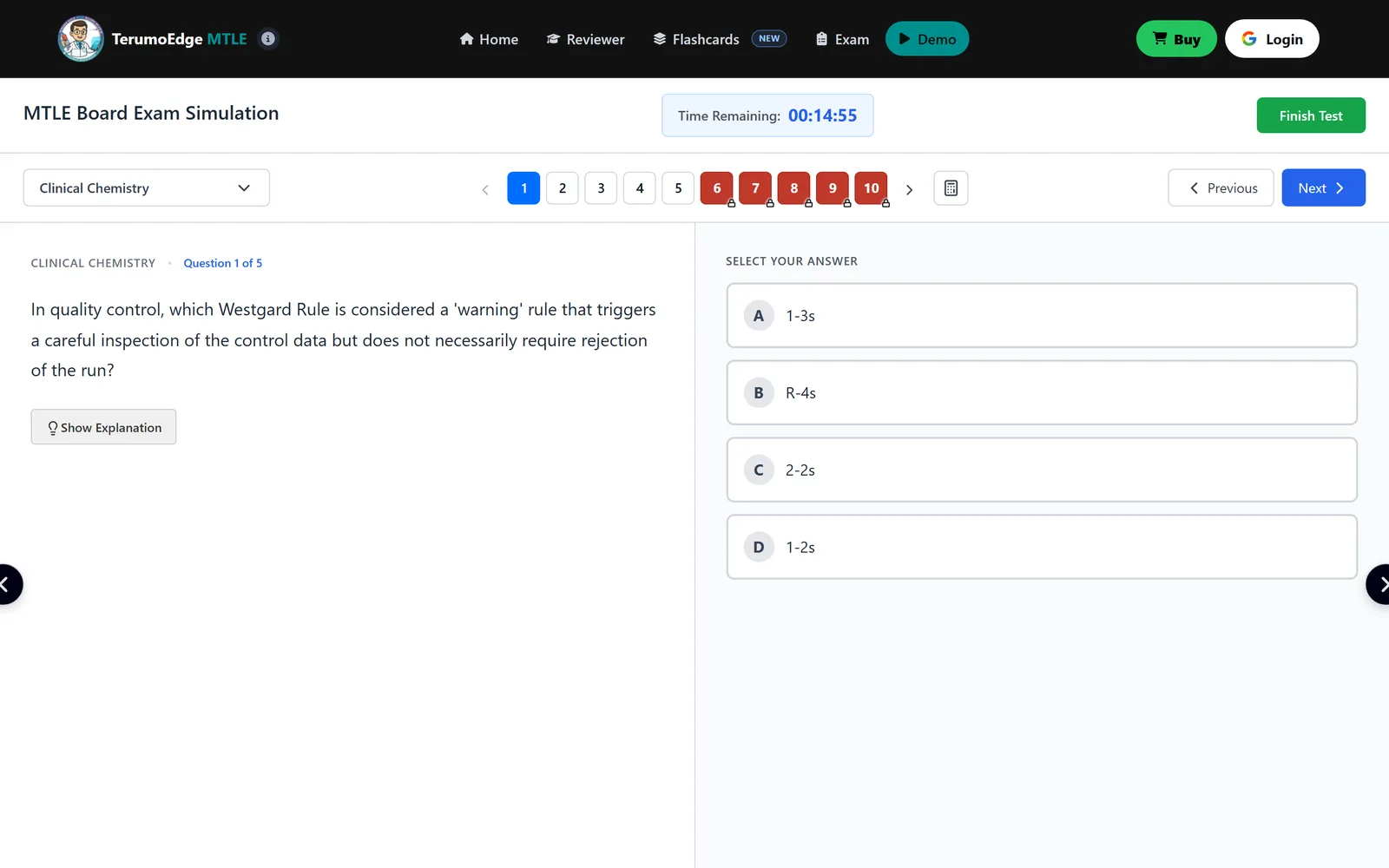
Many medtech reviewees now keep a chatbot open beside their notes, and that habit has real benefits and real risks. This post is a fair look at ChatGPT for MTLE review: what it does well, four specific ways it misleads, and a workflow that keeps the benefits.
A disclosure: TerumoEdge publishes an MTLE simulator, which is a different kind of tool. Our product has no chatbot or AI feature. We have tried to be fair to chatbots, because used well they help.
Is ChatGPT for MTLE a good idea?
A general chatbot is a good tutor and a poor examiner. It helps you understand a concept, and it cannot reliably tell you whether you are ready for a six-paper board exam.
The MTLE is built around a pass rule: a general average of at least 75%, with no rating below 50% in any major subject, per Sec. 19 of RA 5527. Meeting it means measured performance per subject, under time. A chat window gives you none of the three: no measurement, no per-subject view and no clock.
| What you need | General chatbot | Curated timed practice |
|---|---|---|
| Explain a concept in plain words | Strong | Moderate |
| Re-explain until it clicks | Strong | Limited |
| Fixed, board-length timed sets | No | Yes |
| Scores by subject | No | Yes |
| Follows the subject weights | No | If designed to |
| Answers verified by a human | Not guaranteed | Should be |
| Same item for everyone | No | Yes |
Where do chatbots help?
Chatbots help most when you do not understand something and need it explained another way. Ask why a Westgard rule flags a shift, how an agar medium selects and differentiates, or how the coagulation cascade links to a PT result, and you can get a clear, patient explanation at any hour.
They also work as informal quizzers. You can ask for ten recall questions on blood group genetics, answer them, and request a reason for each correction. They can build a mnemonic, translate jargon into Filipino-English study notes, or turn a messy lecture into a checklist.
All of this is useful for understanding, and understanding is half of review. The limits begin where you stop learning and start measuring, because a chatbot cannot give you a fair, repeatable test.
What are four ways chatbots mislead?
Chatbots mislead in four recurring ways, and each is hard to see because the answer reads well.
- Reference ranges and units. Ranges vary by laboratory, method, age and sex, and units differ between conventional and SI systems. A chatbot may give one set confidently, with no note that your exam item or lab uses another.
- Invented explanations. A chatbot can generate a convincing rationale for a wrong answer. Fluent writing is not evidence of accuracy.
- Foreign focus. A lot of the training material is from other countries, so protocols, brands, regulations and even terminology can drift from Philippine practice and from how the MTLE phrases items.
- Inconsistency. Ask the same question twice and the answer may change. For a fact you must remember, that is a problem.
None of these is a reason to avoid chatbots. They are reasons to verify any number, name or method against a textbook or your lecture notes before you commit it to memory.
How do curated explanations differ from generated ones?
Curated explanations are written and checked once, attached to a fixed item, and shown the same way to every reader. Generated explanations are produced fresh each time, and their quality can vary between runs.
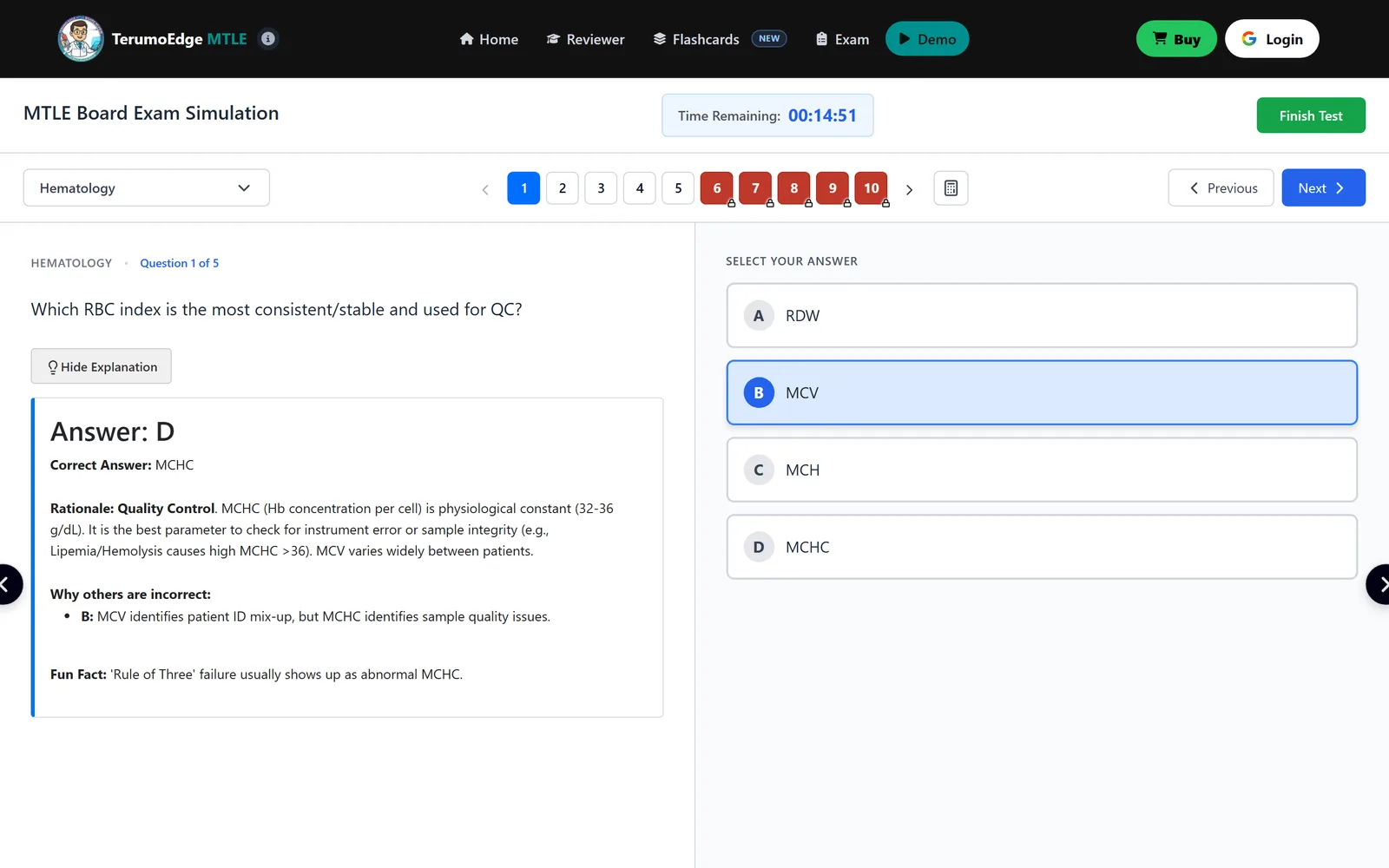
In the TerumoEdge simulator, each of the 3,000 items has an explanation that gives the correct answer, the reasoning and why the other options fail. The explanations are written content, not AI output. That makes them checkable: if you disagree, you can compare against a textbook and know that the text will not change under you.
Fixed items also make progress measurable. A set of 100 items scored by subject, repeated in a month, shows real change. A series of different chatbot quizzes does not, since the difficulty and the topics drift. You can see the format in the free demo.
What is a safe workflow?
A safe workflow uses the chatbot to learn and a fixed set to test. This is a version that works.
- Learn: use the chatbot to understand a topic you find hard.
- Verify: check every number, unit and method against a textbook or lecture note. Write the verified version down.
- Test: answer fixed, timed items, scored by subject, such as a simulator set.
- Repair: for each missed item, read the written explanation, then ask the chatbot for a different angle if it is still unclear.
- Recall: turn the verified notes into flashcards, such as the 1,000 at /flashcards/, and revisit them.
For what the six papers cover and how each is weighted, see the MTLE subjects and weights. For a subject where the number problem is sharpest, read Clinical Chemistry for the MTLE. And to compare tools by criteria, see how to choose an MTLE reviewer app.
How should you prompt a chatbot for MTLE review?
Prompt a chatbot with a narrow task, a stated context and a request to show its uncertainty. Vague prompts invite confident filler.
Useful patterns include: "Explain the principle of this test in four sentences, then give one common interference." Or: "Quiz me on five questions about the coagulation cascade, wait for my answers, then correct me one at a time." Or: "I chose B because of X; tell me where my reasoning fails."
Add the line "Say if a value depends on the method or laboratory." That does not make the answer reliable, but it prompts the chatbot to flag the ranges and units most likely to differ. Then do the step that matters: check the key facts in your textbook. Keep a short list of verified facts and use that list, not the chat history, for revision.
When is a chatbot the wrong tool?
A chatbot is the wrong tool whenever you need a trustworthy measurement or a verified number. Four situations stand out.
Use something else when you want to know whether you are ready, because a chat quiz has no fixed difficulty or per-subject score. Use something else when you are drilling pace, because the chat has no countdown. Use something else when you need a specific reference range or unit, because your textbook or laboratory manual is the authority. And use something else during the final two weeks, when you should be sitting full timed papers, not asking for more explanations.
The pattern is simple: use the chatbot upstream, while you are still learning, and use fixed timed sets downstream, while you are proving it.
Frequently asked questions
Can ChatGPT make MTLE questions?
It can write practice questions in the MTLE style, and they are useful for informal recall. They are not a reliable measure of readiness: the answer keys may be wrong, the difficulty is uneven and there is no link to the subject weights. Use them as extra drills beside a fixed, verified set.
Are chatbot reference ranges reliable?
Not on their own. Reference ranges depend on the laboratory, method, age and sex, and units can be conventional or SI. A chatbot may give one set with confidence. Check ranges against your textbook, and learn the pattern of what is high or low, not a single memorised number.
Can I bring a phone into the exam?
No. Recent PRC programs, as relayed by a secondary source, list mobile phones and smartwatches among the prohibited items, along with books and review materials. That source covers the 2025 sitting, so follow the PRC program for your own sitting.
Does TerumoEdge use AI?
The simulator has no chatbot or AI feature. Its explanations are fixed content attached to each item, and the bank is fixed. You can read a sample in the free demo and judge the quality directly.
Can a chatbot replace a tutor?
For explaining a concept at midnight, it can stand in. It cannot watch you work, notice a habit of misreading stems, or hold you to a schedule. A tutor, a classmate or a lecturer also catches errors that a chatbot repeats with confidence. Use the chatbot as a supplement and keep a human or a textbook as the check.
Sources
From the publisher
Meet the MTLE here first.
TerumoEdge MTLE is an MTLE simulator: board-length practice sets in all six board subjects, sat on a clock, with a full explanation for every item instead of a bare answer key.
- 3,000 items across the six MTLE board subjects, 500 in each
- five board-length sets of 100 items per subject
- A full explanation for every item, not a bare answer key
- A visual reviewer and flashcards beside the question bank
Try the free MTLE simulator demo Five real items per board subject. No account needed.
About this article
Written by the TerumoEdge editorial team, who build the TerumoEdge MTLE Ex-Sim. Exam facts are checked against RA 5527, the Philippine Medical Technology Act of 1969, Professional Regulatory Board of Medical Technology resolutions and PRC announcements, and every article lists its sources. How we write and check our articles.
First published · last reviewed .