
Study strategy7-minute readFor MTLE takers in the final month
MTLE tips for the last 30 days: a week-by-week plan
MTLE tips for the final month: rehearse the two-day sitting, repair your weakest subject, protect recall, and taper. A week-by-week plan with do and don't.
By the last month you either have a base or you do not, and in both cases the MTLE tips are the same: stop collecting, start rehearsing. This guide gives you a week-by-week plan for the final 30 days, a do-and-don't table, and a plan for the night between Day 1 and Day 2. It assumes you have studied each subject at least once; if not, the 12-week study plan is the better place to start.
What is the last month for?
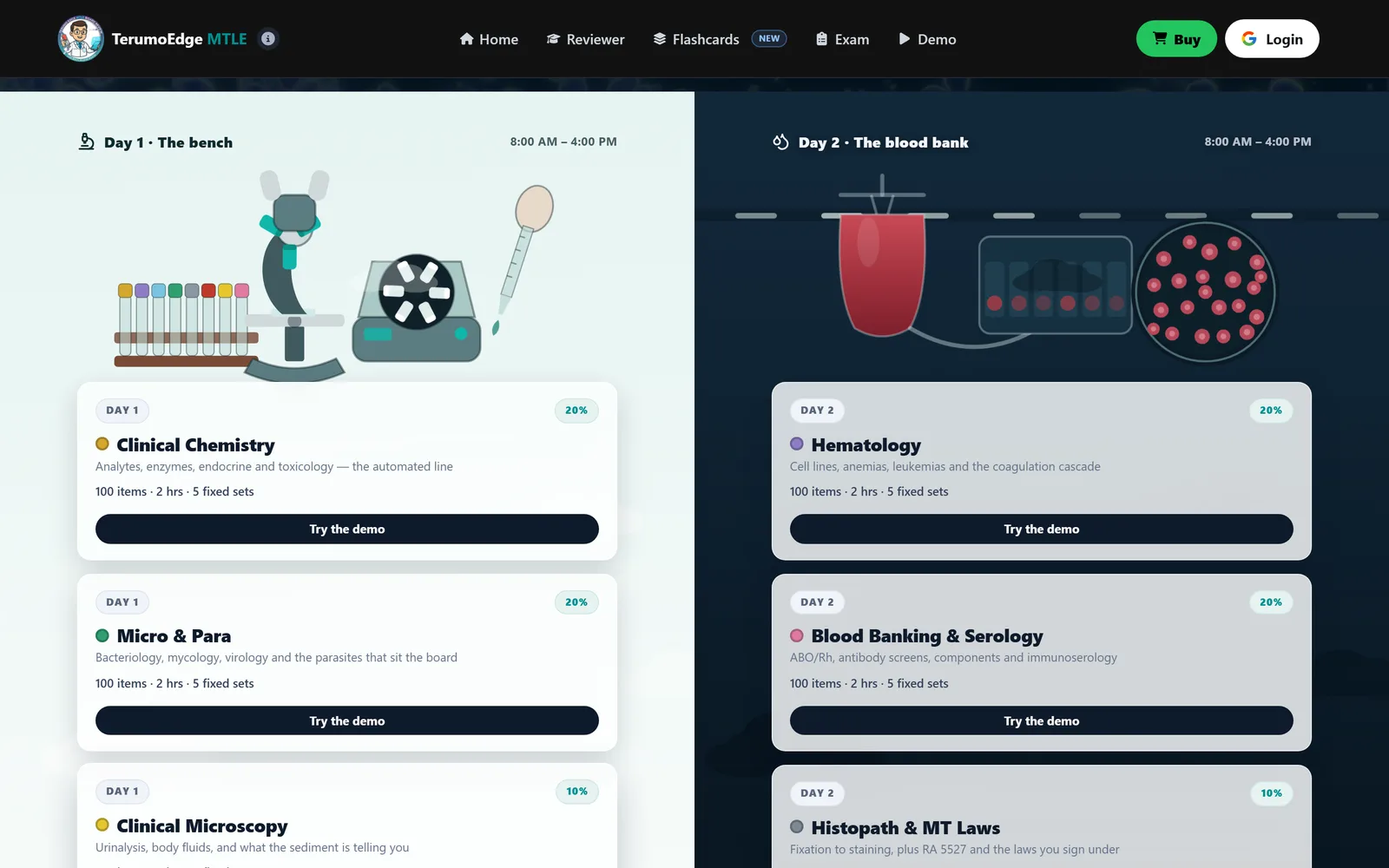
The last month is for rehearsing and repairing, not for learning the course again. Rehearsing means sitting the real shape of the exam: six two-hour papers across two days, from 8:00 AM to 4:00 PM, according to a recent PRC program relayed by Exams Pinas. Repairing means finding the subjects and topics that cost you marks and fixing them with targeted drills.
Two facts should shape your priorities. First, the rule in RA 5527 asks for a general average of at least 75% with no rating below 50% in any of the major subjects, so your weakest paper matters as much as your strongest. Second, your last month sits near the date PRC publishes, so check the 2026 schedule pattern and the current announcement for your sitting.
What should you do in week four before the exam?
In week four out, run your first full two-day rehearsal and take an honest inventory. Sit three papers on Day 1 and three on Day 2, using a board-length set of 100 items for each paper and a two-hour limit. Keep to the real order and the real breaks.
Then spend the next two days on the aftermath. List each subject's score, the time left at the end and the kinds of mistakes. Pick the one subject that sits closest to the 50% floor, and the two topics inside it that cost you the most.
Do not read for the sake of reading. Anything you study this week should be tied to an item you missed. If a topic did not cost you a mark, leave it.
Which MTLE tips help you read your rehearsal results?
The most useful MTLE tips for a rehearsal are about reading the scores honestly. Compare each paper to the 50% floor first, then to the 75% average. A subject near 50% is an emergency even when your general average looks safe, because the rule in the statute treats each major subject separately. A subject at 80% is a reserve you can spend time from.
Look next at the time you had left. Finishing with ten minutes spare and a decent score means pace is fine. Finishing with no time and many guesses means your problem is speed, not knowledge. The time management guide shows how to fix that.
Then look at the shape of the misses. If they cluster in one topic, a one-day repair will pay back quickly. If they scatter evenly across a subject, the cause is probably shallow recall, and flashcards and rule lists will help more than rereading. If they cluster late in the day, the cause is stamina, and your later rehearsals should include the third paper while tired.
Write all of this down on one page. That page becomes your plan for the next three weeks, and you will edit it after every set.
How should you use week three before the exam?
Week three is for repairing your weakest subject with daily, short, targeted sets. Rebuild the topic map for that subject on one page. Then run two timed groups of items a day on its weakest areas, followed by an explanation review in full.
Use other tools besides the question bank. The visual reviewer at /learn/ helps for mechanisms you have never really understood, and flashcards help for facts you keep forgetting. For subject-specific method, see the guides on Clinical Chemistry and Microbiology and Parasitology.
Keep the other subjects alive with one short timed set each. A month is enough to lift a weak subject a few marks, but it is rarely enough to rebuild one from zero. Be realistic, and aim for safe, not perfect.
What happens in week two before the exam?
Week two is for a second rehearsal and a switch to recall. Run the second two-day rehearsal early in the week, and compare it with the first: did the weakest subject move, and did your pacing hold across six papers? If pacing broke in the late papers, practise the later ones while tired.
Then change your study method. Stop reading new pages. Rebuild your rule list: one line per mistake type per subject, written in your own words. Test it with flashcards until the answers arrive before the hints. The time management guide covers the pacing side.
| Week | Do | Don't |
|---|---|---|
| Four out | Full two-day rehearsal; score by subject | Buy a new reviewer |
| Three out | Repair the weakest subject daily | Ignore the other five |
| Two out | Second rehearsal; recall and rule lists | Read new chapters |
| Exam week | Light sets, logistics, sleep | Pull all-nighters or sit full rehearsals |
What should exam week look like?
Exam week is for rest, logistics and light recall. Do one short timed group of items a day, drawn from your own misses, and review your rule list morning and evening. Stop heavy sets two or three days before Day 1.
Settle the checklist early. The program relayed by Exams Pinas lists what to bring (pencils, a black-ink ballpen, envelopes and a single non-programmable calculator, inspected and reset) and prohibits books, review materials, phones and bags. Treat that as a guide and follow the PRC program for your own sitting. The schedule and exam day guide lays it out.
What should you stop doing in the final month?
Stop collecting materials, stop switching plans and stop comparing yourself with other reviewees. Each of these feels like progress and costs hours. A new reviewer in week two out adds new notation, new emphasis and new doubt, just when you most need your existing notes to feel familiar.
Stop long passive reading as well. Reading the same chapter a third time gives a feeling of fluency that is not the same as recall. Replace it with closed-book retrieval: write what you remember, then check. That is what the exam asks you to do.
Be careful with social media groups in the last weeks. Rumours about topics, unverified predictions and arguments over answers circulate fast. None of it comes from a source you can check, and the PRC program and the statute are what count. If you want a calmer routine, the anxiety guide covers it.
Finally, stop treating a weak rehearsal as a verdict. A rehearsal measures where you are on one day. It is useful because it is early enough to act on.
What do you do between Day 1 and Day 2?
Between the two days, protect sleep first, food second and review third. Your Day 1 papers are finished, so resist the urge to re-check them. Whatever you got wrong on Chemistry cannot be changed, and the energy you spend on it costs you on Hematology.
Eat a proper meal, hydrate, and spend no more than an hour reviewing your Day 2 rule lists: Hematology, Blood Banking and Serology, and Histopathologic Technique with laws and ethics. Avoid group chats that dissect Day 1 items. The talk rarely helps and often unsettles people.
Prepare your bag and your clothes, set two alarms, and go to bed at your normal time. If you cannot sleep, rest anyway. Quiet rest still helps more than a late set.
Frequently asked questions
Should I study the night before the MTLE?
Keep it light: a short review of your rule list and the checklist, then stop. New material the night before tends to unsettle more than it helps. Sleep and a calm morning are worth more than another hour of reading.
What should I review between Day 1 and Day 2?
Review only the Day 2 papers, using your rule lists and flashcards, for an hour at most. Do not go back over Day 1. Eat, rest and sleep, because Day 2 begins at the same early hour and demands the same stamina as Day 1.
Can I fix a weak subject in one month?
You can often lift it, but you may not be able to rebuild it from nothing. Daily targeted sets, careful explanation review and recall can add real marks. Because every major subject has a 50% floor, make your weakest paper the priority and keep the others warm. See the passing score and rules.
Is it better to do more sets or review more?
Review more. A set teaches you only as much as the review that follows it. Doing one set and reading every explanation, then writing a rule for each miss, beats two sets with a quick glance at the score.
Sources
From the publisher
Meet the MTLE here first.
TerumoEdge MTLE is an MTLE simulator: board-length practice sets in all six board subjects, sat on a clock, with a full explanation for every item instead of a bare answer key.
- 3,000 items across the six MTLE board subjects, 500 in each
- five board-length sets of 100 items per subject
- A full explanation for every item, not a bare answer key
- A visual reviewer and flashcards beside the question bank
Try the free MTLE simulator demo Five real items per board subject. No account needed.
About this article
Written by the TerumoEdge editorial team, who build the TerumoEdge MTLE Ex-Sim. Exam facts are checked against RA 5527, the Philippine Medical Technology Act of 1969, Professional Regulatory Board of Medical Technology resolutions and PRC announcements, and every article lists its sources. How we write and check our articles.
First published .