
Comparisons8-minute readFor medtechs planning to work abroad
MTLE vs ASCPi vs AIMS: three exams for three different careers
MTLE vs ASCPi vs AIMS: three exams run by three different bodies. See which one fits your plan, what to confirm with each body and how to sequence them.
If you are a Filipino medical technologist thinking about working abroad, you have probably compared the MTLE vs ASCPi and AIMS and wondered how they fit together. They are not three levels of one exam. They are three exams run by three different bodies for three different purposes, and this guide helps you think about which fits your plan.
We keep to what we can source: RA 5527 and PRC for the MTLE, the ASCP Board of Certification's official content guideline for ASCPi, and the AIMS examination pack and assessment guidelines for AIMS. Where those documents are silent, we say so. TerumoEdge, which publishes this blog, also publishes separate simulators for those exams, so weigh our views accordingly.
MTLE vs ASCPi vs AIMS: why are they different exams?
These exams are different because each body sets its own rules for its own purpose. The MTLE is the Philippine licensure examination under Republic Act No. 5527, run by the Professional Regulation Commission (PRC) through its Board of Medical Technology. ASCPi and AIMS belong to other organisations and other jurisdictions.
That means their eligibility rules, formats, fees, schedules and recognition are not set by PRC. A pass rule or an item style from one exam should never be assumed for another.
| MTLE | MLS(ASCPi) | AIMS Professional Examination | |
|---|---|---|---|
| Run by | PRC Board of Medical Technology, under RA 5527 | ASCP Board of Certification | Australian Institute of Medical and Clinical Scientists |
| What it is | The Philippine licence | An international certification exam | Stage 2 of a skills assessment for migration |
| Format | Six papers over two days | 100 one-best-answer questions in 2 h 30 min, computer adaptive | 150 single-response questions in 3 hours, online, remote proctored |
| When | March and August in 2026 | Confirm with ASCP | March and September |
| To pass | 75% general average, no major subject below 50% | A scaled score of at least 400 on a 100–999 scale | 75 of 150 correct, plus minimums in named disciplines |
What is the MTLE?
The MTLE is the Philippine Medical Technologist Licensure Examination. Under Sec. 19 of RA 5527, you pass with a general average of at least 75% and no rating below 50% in any major subject. After three unsuccessful examinations, a 12-month refresher course or postgraduate training is required before another attempt.
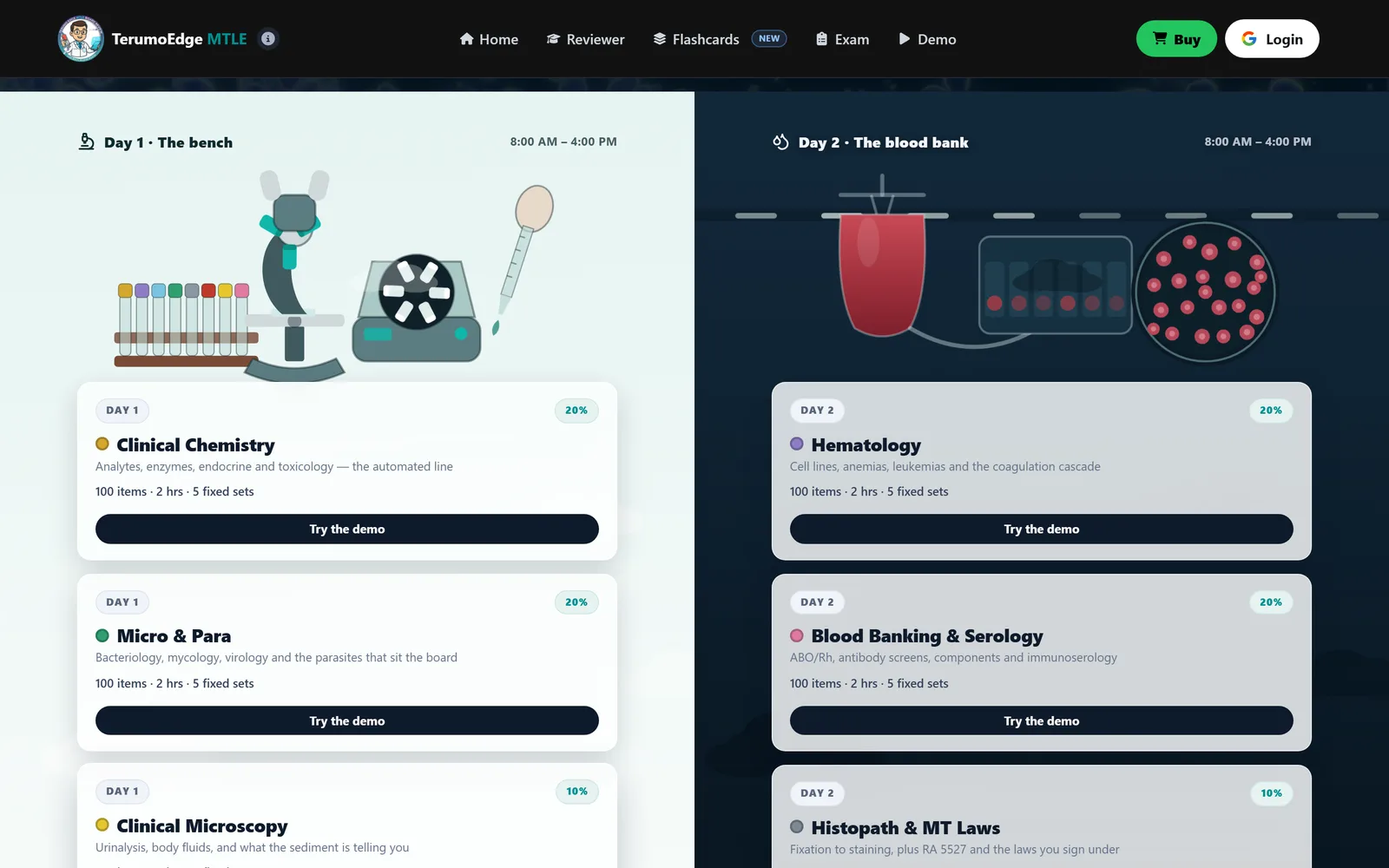
The subjects, per Sec. 17, are Clinical Chemistry, Microbiology and Parasitology, Hematology and Blood Banking and Serology at 20% each, and Clinical Microscopy and Histopathologic Technique at 10% each. PRC held sittings on 5 to 6 March and 15 to 16 August in 2026, according to its 2026 schedule.
There is a separate rule for scores just below passing, owned by another post. In one line, a general rating of at least 70% allows registration as a Medical Laboratory Technician.
What does the ASCPi exam test?
The MLS(ASCPi) exam has 100 multiple-choice questions with one best answer, delivered by computer adaptive testing in 2 hours 30 minutes, according to the ASCP Board of Certification content guideline. The same guideline covers the US MLS(ASCP) exam.
Its seven content areas overlap with the MTLE's six subjects but are not the same list:
- 17–22% each: Blood Banking, Chemistry, Hematology and Microbiology.
- 5–10% each: Urinalysis and Other Body Fluids, Immunology, and Laboratory Operations.
One difference matters for Filipino reviewees: regulatory questions are based on US sources such as AABB, FDA and CLIA, not Philippine law. Laboratory Operations is also its own area.
Scoring is different too. ASCP reports a scaled score from 100 to 999, and the minimum passing score is 400, not a percentage. A candidate may sit the exam five times under one eligibility route, with at least 30 days between attempts.
What is the AIMS Professional Examination?
The AIMS exam is part of Australia's skills assessment for Medical Laboratory Scientists (ANZSCO 234611). AIMS is the assessing authority for that occupation under Australia's Migration Regulations 1994, per its assessment guidelines.
The examination pack sets 150 single-response questions in three hours, sat online and remote proctored each March and September. Passing needs 75 correct answers overall, at least 50% in five named disciplines (including Haematology and Transfusion Science), and 50% in either Molecular Pathology or Immunopathology.
Not every applicant sits it. AIMS describes three options:
- graduates of an AIMS-accredited degree need no exam
- applicants with another acceptable science degree and at least two years' postgraduate laboratory experience sit this exam
- some postgraduate applicants sit a separate written exam instead
AIMS assesses each qualification case by case, so ask it which option fits you. We say nothing about visas; that belongs to Australia's immigration authority.
TerumoEdge publishes separate simulators for the ASCP international exam, for Australia's AIMS assessment and for the Gulf Prometric exams for laboratory scientists. They are different products from the MTLE simulator. We list them at /products/ and make no claims here about those exams.
How do you decide the order?
Decide the order by your goal and your deadlines, not by guesswork. Ask four questions, in order.
- Where do I want to work first? If the answer is the Philippines, the MTLE comes first, because it is the licence.
- What does the target body require? Read its eligibility page. If it asks for a licence or a degree, note which.
- What are the dates? PRC sits twice a year, in March and August. Other bodies set their own calendars, so check each.
- What can I afford in time? Two serious reviews at once rarely work.
Whether the MTLE must come before ASCPi or AIMS is a question for those bodies, and we will not guess. If your plan starts with the Philippine licence, the practical steps are in the first-time taker guide and the schedule and exam-day guide.
How do you prepare without splitting your focus?
Prepare for one exam at a time, and let the earliest deadline win. The MTLE is a heavy review of six subjects, and mixing in a second exam's materials during the same weeks dilutes both.
Finish the MTLE cycle first if it is your first exam: build content, then rehearse the two-day sitting with timed sets. Keep a short notes file of anything you meet that may be useful later, but do not start a second syllabus.
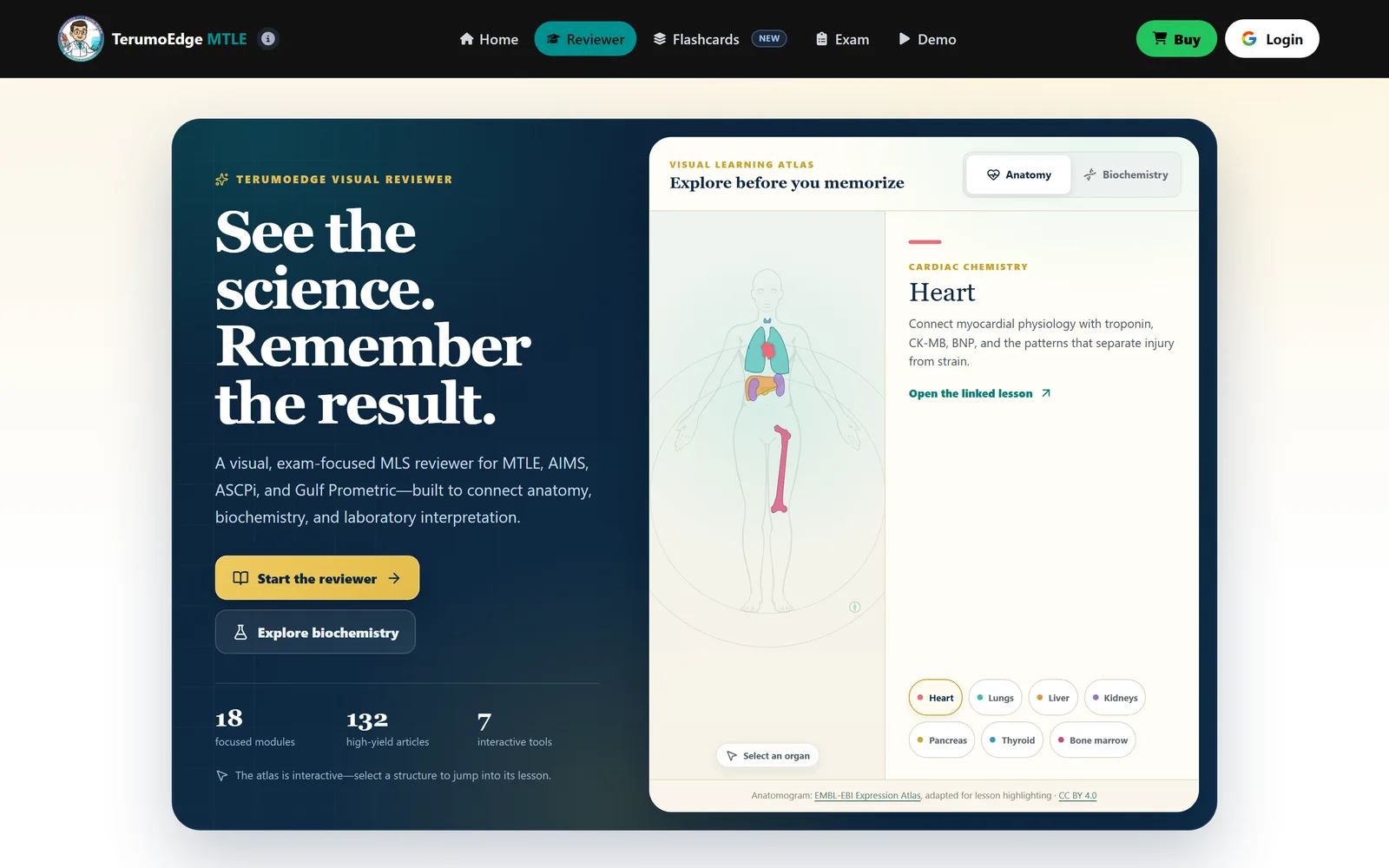
Once the result is out, you can begin the next review with the same habits: timed practice, per-subject scores and explanations for every item. Choose a simulator made for that exam, because its structure differs. The MTLE simulator guide explains the method, and you can try the free MTLE demo for five items per board subject.
What should you confirm with each body?
Confirm four things directly with whoever runs the exam: who is eligible, what the format is, what the result allows and what the calendar and fees are. Do this in writing, from the official page, on the day you decide.
For the MTLE, the sources are RA 5527 and PRC's published schedules. For the other two, go to the organisation itself and keep a screenshot or saved copy of the page you relied on, since requirements change. Ask your target employer or regulator, in the country where you plan to work, what they accept. A friend’s experience is a useful lead but not a rule.
Never rely on a blog post, including this one, for another body’s requirements. We list what we can source about the MTLE, and we point you to the right place for the rest.
What if you are planning a longer path?
If your plan spans several years and more than one country, treat the exams as separate projects with their own deadlines. A written timeline helps more than a general intention.
List each target exam with its eligibility date, filing window and sitting date. Mark which ones depend on your Philippine licence being in hand, according to the body that runs the later exam. Leave a gap between reviews, because the MTLE alone is a two-day, six-paper sitting that takes a full review cycle.
Keep your records tidy: transcripts, licence documents and certificates. Many processes ask for them, and gathering them late costs weeks. If you retake the MTLE first, the retaker plan and the passing rules post will keep your attention on the sitting in front of you.
Frequently asked questions
Do I need the MTLE before ASCPi?
We cannot say. Eligibility for ASCPi is set by the body that runs it, so confirm the current requirements with ASCP directly. A Philippine licence may matter for working in the Philippines regardless, but whether another body asks for it is that body's rule.
Is ASCPi harder than the MTLE?
We make no claim. The exams are run by different bodies, with different content, formats and scoring, so a comparison of difficulty would not be fair or sourced. Judge each by its own published outline and prepare with materials built for it.
Does TerumoEdge cover ASCPi?
Yes, as a separate product. TerumoEdge publishes separate simulators for the ASCP international exam, Australia's AIMS assessment and the Gulf Prometric exams. The MTLE simulator is its own product and does not prepare you for those. See the products page for each.
Does passing the MTLE let me work abroad?
We make no claim about recognition abroad. Whether any country or employer accepts a Philippine licence is decided by that country's regulator or the employer. Ask them directly and keep a written record of the answer.
Should I sit the MTLE and another exam in the same year?
It depends on the dates and your capacity. The MTLE is a six-paper, two-day sitting held in March and August, and it needs a full review. Check the filing windows and sitting dates of the other body, then ask whether one review will leave you too tired to prepare properly for the other.
Sources
- Republic Act No. 5527, Philippine Medical Technology Act of 1969 — Lawphil
- 2026 Schedule of Examination — PRC
- MLS(ASCP) and MLS(ASCPi) Examination Content Guideline, revised September 2025 — ASCP Board of Certification
- About the Examination — ASCP Board of Certification
- After the Examination — ASCP Board of Certification
- Professional Examination Pack, Medical Laboratory Scientist, v8.2 — AIMS
- Guidelines for Skills and Qualifications Assessment, MLS and MLT, v18.2 — AIMS
- TerumoEdge ASCP international exam simulator — TerumoEdge
- TerumoEdge AIMS simulator — TerumoEdge
- TerumoEdge Gulf Prometric MLS simulator — TerumoEdge
From the publisher
Meet the MTLE here first.
TerumoEdge MTLE is an MTLE simulator: board-length practice sets in all six board subjects, sat on a clock, with a full explanation for every item instead of a bare answer key.
- 3,000 items across the six MTLE board subjects, 500 in each
- five board-length sets of 100 items per subject
- A full explanation for every item, not a bare answer key
- A visual reviewer and flashcards beside the question bank
Try the free MTLE simulator demo Five real items per board subject. No account needed.
About this article
Written by the TerumoEdge editorial team, who build the TerumoEdge MTLE Ex-Sim. Exam facts are checked against RA 5527, the Philippine Medical Technology Act of 1969, Professional Regulatory Board of Medical Technology resolutions and PRC announcements, and every article lists its sources. How we write and check our articles.
First published · last reviewed .